You Should See Them Live: Marina and the Diamonds (Bogarts in Cincinnati)

One of modern music’s intricacies is trying to find out just how “big” is a particular artist. This can be simple in some cases, i.e: Justin Timberlake is very big while Waxahatchee is very small, but there are thousands of artists for whom you can triangulate social media presence, record sales, and media buzz, and still be way off on their actual size. Take Marina and the Diamonds for example. MatD show up all over on Tumblr and Twitter fanpages and in mash-ups online (just casually tweeting about them is enough to get fan account favorites/follows), but their highest charting album went to no. 8 in America. Their pop career in native U.K. could be generously described as transient–Electra Heart had the dubious honor of being the lowest selling number one album at the time, and its follow up FROOT peaked at no. 10. So, when you hear that they’re playing the local rock shed, you think the crowd’ll be interesting, but not the biggest draw in town.

And yet.

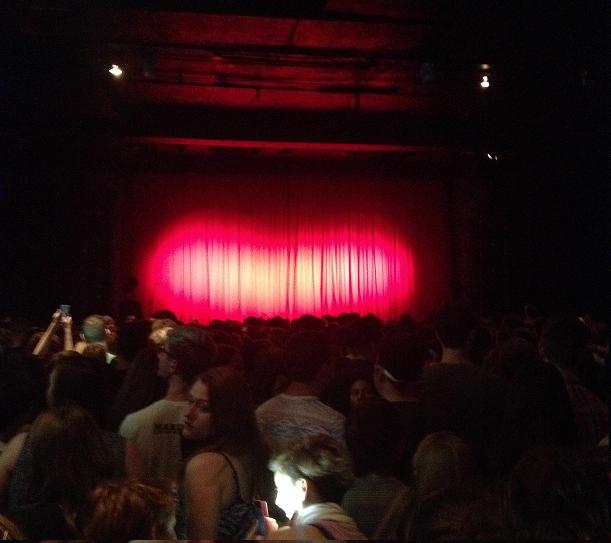
Even after the doors opened, the line to get in Bogarts ran down both sides of the street, and on further inspection, the marquee declared the show officially sold out. Looking at the technicolor queue, I immediately realized I’d undersold how Marina’s online fanbase translated into physical bodies (I was about as immediately thankful my girlfriend leaped on this show when it was announced and we’d had tickets for months). Attribute it to any number of factors: the show being on a Friday night, last week marking the end of the year for most schools, MatD’s general likability, or the fact that no one plays Cincinnati back-to-back and if you see a show you’ve just gotta go for it, but no matter what, The Diamonds (nickname for MatD’s fanbase) were out here.
IMG_1951

I don’t think I’ve seen a crowd as ready to go, too. The curtain stayed closed while the band set up, and the slightest bump or movement behind it elicited cheers and sustained chants of “MA-RI-NA!” for whichever sound tech was setting up a microphone. This happened at least three times. But, it was nothing compared to the exuberance that hit once Marina and the band came out and launched into “Bubblegum Bitch”, the biggest concert opener in her discography.

Marina’s music sounds expertly performed on albums, and that same presence transfers to her live show. She always played out to the crowd, invited us to sing along (which, as a baritone, was a bit daunting), and I don’t think she ever stayed entirely still; she was always dancing or strutting across the stage, and doing it with a smile. I was actually a little off in my review of FROOT: she didn’t break out a spotlight for “Happy”, but played it solo(ish) behind a keyboard, and the mass singalong was the sweetest moment of the night.

mynamesmarinaReally, it’d be hard to pick a point where the show slumped in any real way. Marina and the Diamonds aren’t going to deviate from the way they sound on record; sure, the drums hit harder and the vocals were stronger in the mix, but it’s not like “I’m a Ruin” suddenly became a power ballad. The live sound brought a little more slapstick energy to older songs like “I Am Not a Robot” and “Mowgli’s Road”, and FROOT highlights like “Blue” and the title track only sounded stronger free of the album’s echoing production. I was actually wondering about that transition before the show; FROOT was made with a guitar/bass/drums/synth band set-up, but had a heavily produced studio sound would be hard to replicate live. And, while “Better Than That” still sounded flat-footed and “I’m a Ruin” didn’t quite click, most of the songs did, with “Savages” even sounding better freed of the gauzy album sound.

You can always tell an artist’s feelings toward an album based not only on what they play at a show, but what they don’t play, either. Even as a tour supporting the album, the setlist was a venerable FROOT basket: a whooping eight songs were pulled from that record with only “Immortal”, “Weeds”, “Gold”, and “Soilitare” (a personal favorite) left untouched. Meanwhile Electra Heart, an album Marina has politely but pointedly left in her rear view, was absent for the first half of the set outside “Bubblegum Bitch”. She eventually came back for “Lies” and “Primadonna” and closed with a one-two combo of “Radioactive” (the only genuine surprise of the evening) and “How To Be a Heartbreaker”, all of which were rapturously received. A Heartless set makes some sense with MatD’s current line-up–the line-up was designed with FROOT in mind, after all–but seeing an artist take a “deep cuts, too” approach for one album and “hits only” for another tells you a lot about favorites.

Not that anyone probably minded. Marina and the Diamonds put on a stand up show in front of an adoring audience. Whenever Marina spoke to the crowd during the show, it felt personal, or as personal as you can get from fifty feet away. There’s a very genuine, mutual connection between Marina and the fans. As the lights came up, my friends and I realized (to our quarter-life crises horror) that this was an incredibly young crowd, most of which didn’t have the “beer me” wristbands you get at the door. With how intensely The Diamonds love this band, it seems understandable that the fanbase would skew young–what better time is there to have an artist be your life than as a young adult? The world finally came to them for a night, and they made the best of it. So did us bitter adults, too.
Posted in "Thoughts" | Tagged , , , , , , , , | 1 Comment

Feedback – Reel Big Fish: Why Do They Rock So Hard?

Welcome back to “Feedback”, a series I started and kind of abandoned awhile back where I look at an artist’s lesser known album to see what that album was, and what’s been missed by ignoring it. Today’s album is ska band Reel Big Fish’s 1998 album Why Do They Rock So Hard?

There are few things I could tell you about myself more embarrassing than how into ska I used to be. I will gladly, gladly embarrass my self by extolling the virtues of Evanescence’s album Fallen, or reciting the words to RENT‘s “La Vie Boheme” before disclosing how many ska albums I bought the first summer I had a job. Let me put it this way: I willfully called it the Ska-plosion. And, because my poison wasn’t just ska but fucking 90s ska, I had muttonchops. Just thank the stars no porkpie hats or Hawaiian shirts were involved.

Okay, so because some of you had lives in high school, let’s take a quick look at what ska (specifically ska punk) actually is, and how it went from Caribbean origins to the preferred genre of mid-90s chuckleheads. Ska started in Jamaica around the 1950s as a cultural cross pollination between southern US R&B and local Caribbean rhythms; this was basically proto-reggae that emphasized the off-beat and guitar upstrokes. This sound emigrated with large numbers of Jamaicans to the UK in the 70s, and the somewhat punk-y 2 Tone ska was born in the shared space between poor Jamaican immigrants and working class members of nascent punk.

And then, 2 Tone bands influenced pockets of the American punk underground in the late 80s/early 90s that would peak later that decade; your No Doubts, your Mighty Mighty Bosstones, Sublimes, Reel Big Fish, and Less Than Jakes. Third wave ska fit in enough with the punk side of Alternative Nation to break through because it typically looked like a more limber and horn-based pop punk offshoot with the same relationship drama, but ratcheted up the cheekiness. Essentially, anyone who found something in Dookie or Smash wouldn’t have trouble listening to Hello Rockview or Tragic Kingdom (this also works going present to past: you dig deep into Paramore, Fall Out Boy, or The Front Bottoms; you find Fueled By Ramen or old Warped Tours; you find Less Than Jake or Reel Big Fish).

Even nowadays, there’s something permanently Teenage about ska that goes beyond the tongue in cheek cynicism in the lyrics and high-calorie music (I’m aware I am probably projecting here). Be it the lethal levels of kitsch in the aesthetic, the winking huckster presentation across the board, or the fact that it’s impossible to skank without looking unfortunate, ska seems, by design, like too much to be taken or appreciated entirely seriously. It’s one of those things you like or do partly because yeah, you find it palatable enough, but you’re also cultivating your own eccentricity; like always getting pineapple and banana pizza or wearing fingerless gloves. No one just happens into ska. Likewise, you have to be a particular kind of person to join a ska band in the first place.

Enter preeminent kitschy hucksters Reel Big Fish.

Reel Big Fish didn’t start as a ska band, but they became the ska band. You can argue whose flatout best all day (have fun!), or point out that other bands had bigger careers; no one else chained themselves to ska as an identity to the point that they wore “SKA BAND”  jumpsuits in a big budget music video. Reel Big Fish kept their music firmly in ska without budging: every song on 1996’s Turn the Radio Off was a blast of power chords, bright guitar upstrokes, syncopation, air-guitar inducing solos, bouncing hornlines, and snarky slacker lyrics. You get chucklehead shit like “She Has a Girlfriend Now” and “Skatantic”, but also “I’ll Never Be” and “Snoop Dogg, Baby”, which are affecting enough in a bro-y way to convince you this band has a heart underneath the grinning cynicism.

Follow-up record Why Do They Rock So Hard? (released in 1998) pushes the ska-iest ska band into ska-ing their hardest. The horns put in overtime, showing up not just on choruses and hooks, but weaving in and out of verses like on “Brand New Song” and “The Kids Don’t Like It”, adding zany licks wherever possible. Ska aficionados tend to be in favor of more horn whenever possible; this is an album that’s eager to unleash its inner high school band kid on the world. True to the album title, lead singer/guitarist Aaron Barrett pushes his riffs all the way into the front; the first thing you hear upon firing up this album is a guitar solo pushed into the red. This was 1998: bands no longer felt like they were under contractual obligation to avoid any and all appreciation for 80s pop metal they might have had. WDTRSH? indulges in super overdriven and bottom heavy riffs and flashy solos; it’s the only ska album that could have credibly been produced by Mutt Lange. Actually, the album could have used Lange’s production instead of the loud, claustrophobic mix here where everything bleeds into one noisy mess, making this an album that’s sound is as garish as its album cover.

But, despite how violently this album pushes into rawk, it also doubles as RBF at their most chill. After an opening salvo of ska punk, “I’m Cool” is straight up reggae, and after gimmicky, shrill anger on “Everything Is Cool”, “Song #3” is a mellow jam with Coolie Ranx that’s more interlude than anything. Elsewhere, “Thank You For Not Moshing” alternates between brisk (oh, this hurts to type) “pick it up, pick it up, pick it up!” ska tempo and half time horn-led verses, and “Big Star” and the extra sardonic “We Care” are probably some of RBF’s straightest ballads.

Along with up-sizing everything else, WDTRSH? doubles down on the sarcastic cynicism of its predecessor. This schtick felt at least halfway forgivable on Turn the Radio Off because even “She Has a Girlfriend Now” or “Trendy” were delivered with a light chuckle. When Barrett sings “I’ve got a brand new song/It is so lovely, lovely/I’ve got a brand new attitude/It is so hateful, hateful” on “Brand New Song”, it’s the album’s thesis statement delivered with a smirk.

No longer in a band that’s just trying to make it, Barrett’s use of jokey sarcasm and irony no longer covered his insecurities, and wound up just being an end in themselves. This is how you get one-note shit like “I Want Your Girlfriend To Be My Girlfriend”, “You Don’t Know”, “Thank You For Not Moshing”, or “We Care” where the ironic delivery isn’t for a joke or deeper point, but someone grandstanding while reveling in their misery. Ex-girlfriends get their share of grief, but Barrett’s target for most of the album consists of nebulous RBF haters who called them sell outs after, well, y’know. About half the album is defensive posturing against critics or the band talking about how much they hate their own success and how the whole thing is going “Down in Flames”. That bitterness becomes harder and harder to tolerate as the album marches closer to an inflated hour runtime.

It is, perhaps, appropriate then that WDTRSH? landed with a thud upon release. The burst of the ska bubble hurt Reel Big Fish the most since, of the bigger ska bands, they were the least diverse. No Doubt’s Tragic Kingdom (released before even Turn the Radio Off) had it’s ska credentials, but ultimately transcended the scene and became a 90’s staple. The Mighty Mighty Bosstones leveraged their goodwill in the punk scene from their early days to exist in smaller scenes. Less Than Jake had it both ways in the late 90s through the 00s by zig-zagging between “kind of a ska band” and “kind of pop punk with occasional horns” (sidenote: LTJ’s Hello Rockview holds up best in the late-90’s ska field, and GNV FLA from 2008 is still a personal favorite). Meanwhile, Why Do They Rock So Hard? is ska’s Be Here Now: a record that thought the water was fine before diving in head first and experiencing the cold shock of a disinterested public.

After a slight rebound with the more power pop Cheer Up!, Reel Big Fish fell out of the mainstream with We’re Not Happy ’til You’re Not Happy, an album too tiring and joyless for even my sneering teenage self. Since then, they’ve subsisted with a few same-y albums, a grueling touring schedule (I saw them in 2011 splitting a bill with Streetlight Manifesto, the thinking teen’s ska band), and enough lineup changes to make The Smashing Pumpkins look stable. As long as Barrett can keep cracking out casual misanthropy over hair metal solos and reggae horns while finding dudes to play them, he should be able to keep playing midsize theaters and state fairs as his pompadour and muttonchops turn grey.

For my part, I aged out of ska. A lot of it came down to ska, like that pineapple and banana pizza, being the kind of novelty you can only have so much of. But part of it was definitely that late teens pose of looking as mature and adult as possible, and in my mind, nothing screamed adolescence like checkered patterns and guitar upstrokes. And beside, I had a through line for more interesting punk: one of my last discoveries (or “discskavories”, you could say) was Arrogant Sons of Bitches, an underground DIY group lead by a manic Long Islander name Jeff Rosenstock, seen here in the tie & t-shirt combo. ASOB called it quits by the time I heard of them, but Rosenstock’s new collective Bomb the Music Industry! became one of my forays off the beaten path of alternative rock, and I only went down the rabbit hole from there.

Why Do They Rock So Hard? shows ska at its cultural peak, but peaking just means the ride’s about to end. It wasn’t the only high profile ska album from that year–Less Than Jake’s Hello Rockview and Catch 22’s acclaimed Keasbey Nights also had 1998–but the RBF were as ska as it got. I wanted to see if WDTRSH? was unfairly judged commercially, and maybe even see if I could reconnect with the music I used to listen to. But honestly, the album’s flop was earned, and the self-aware mugging and cynicism only reminded me of why I fell out of ska in the first place. Ska wasn’t meant for prolonged mainstream exposure; some fish are better in a smaller pond.

Posted in Uncategorized | Tagged , , , , , , , , | Leave a comment

Radio Rant: Jason Derulo – “Want to Want Me”

Hello, and welcome to Radio Rants. Get jazzy on it.

Here’s one for you: Jason Derulo’s career is five years old at this point. That’s like, a decade, in pop music years; a five year career means you’ve likely survived two to three albums, your breakout trend crashing and burning, and probably had to rebound at least once. You’re basically a pop veteran. What makes this milestone remarkable for Jason Derulo is that there’s never been a time where he wasn’t fucking awful. You look at other longrunners with recent misfires, and there’s an “at least” defense: at least Wiz Khalifa used to be a credible mixtape rapper, at least Maroon 5 has “This Love” and “Sunday Morning”, or at least Chris Brown’s a decent performer. There’s no such defense for Derulo, who has been terrible since Day One. His singing’s always been over Auto-Tuned or over processed, he’s never been a commanding presence, and his songs are obnoxiously gimmicky without any other defining features. He almost ran out of steam around “The Other Side” (which is only boring instead of actively bad), but ever since “Talk Dirty”, we’ve been in a Derulaissance that’s seen him get hits off songs that have to be written this badly on purpose. You can’t tell me that “Wiggle” was ever conceived as anything but the worst.

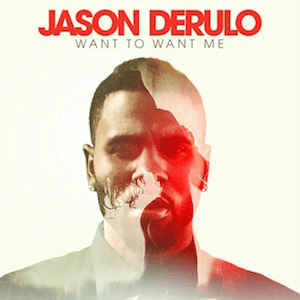
Speaking of the worst, let’s talk about “Want To Want Me”. The song’s the lead single from Derulo’s upcoming album, so it’s a bit of a break from the tacky brass and woodwind instrumentation grafted onto “Talk Dirty”, “Trumpets”, and “Wiggle”. In fact, “Want To Want Me” is pretty much straight electropop. A stuttering bassline and programmed drumbeat lead the way in the verses, while the chorus gets outlined in quick synth blasts and occasional group vocals. It’s a smoother sound than anything Derulo’s had before, but that’s not encouraging. The guy’s past beats have relied on, as I mentioned before, some sort of gimmick or an obvious sample, but “Want To Want Me” sounds like it was the first thing queued up in GarageBand. It’s the gas station knockoff Slushi of summer pop.

This sweet and slushed iteration marks new(ish) territory for Derulo. There are still whiffs of Axe coming from “Want To Want Me”, but it’s tamer than the Tattoo/Talk Dirty cycle, which felt like being smothered in an Axe-drenched bro-tank. The sneering horndog from that era’s been replaced by a wedding singer with transparent aspirations of being JT/Drake/MJ/pre-lawsuit-Blurred Lines-era Robin Thicke/whatever guy’s riding an R&B hit right now. It’s a pedestrian move, and not a great one for Derulo, who’s never been a capable vocalist (Does Jason Derulo have a good falsetto? Spoilers: No). Derulo’s been saved multiple times, even in the pre-“Talk Dirty” days, by his songs being kind of stupid, but “Want To Want Me” is stupid in a boring way.

“It’s so hard to sleep/I got the sheets on the floor” Ugh, but what if you wake up cold at like, 4:00 AM? That’s the worst.

“In the back of the cab/I tip the driver, head to town” I can’t help but think Derulo’s dating himself here by getting a cab instead of Uber.

“I got your body on my mind/I want it back” How can you get it back if it’s not y–never mind, I’m not thinking about this.

“Girl, you don’t want/I want you to want me/And if you want, hey girl/You got me” Okay, so this chorus is not good, but I’m just going to appreciate that Derulo was maybe/probably inspired by two of the best power pop songs of all time.

“You open the door/There ain’t nothing but a smile drawn to the floor” I just realized: Jason Derulo doesn’t say anything before he comes over; he just shows up. Not even an “wyd?” Obviously, we know this didn’t happen in the way we know any club story that ends with “we totally had sex” didn’t happen, but the entire premise of “Want to Want Me” so paper thin it reads as funny more than anything else. Okay, sure, you just bomb over to this girl’s place and you have sex. Sure, Jason.

“Want To Want Me” ends up in an aggravating spot. It’s not bad enough to cause spittle-covered rage like a sizable chunk of Derulo’s catalog, but it’s not good, either. It’ll probably show up again on the Songs of the Summer charts and be used to signal the point where the DJ’s officially run out of hits at the wedding reception, but I’ll be ready to ditch this bland grab bag come fall. But, I expect this isn’t the last we’ll see from Derulo. He always wiggles into a hit, one way or another.

Posted in Radio Rants | Tagged , , , , , , | Leave a comment

Album Review: Mumford & Sons – Wilder Mind

“Fuck the banjo.”

Well, points for honesty. Mumford & Sons’ first two albums 2009’s Sigh No More and 2012’s Babel were massive commercial (if not critical) successes that spearheaded the pop-folk movement and made Mumford a festival banner name, but I get where they’re coming from on “Fuck the banjo”. If I spent the last five years making my living by playing variations on the same “BAH-lol-lol, BAH-lol-lol, BAH-lol-lol, BAH-lol-lol” banjo arpeggio, I’d be tired of the damn thing, too. It’s a small miracle one of the Sons never reenacted this scene on stage. But the Mumford model, even if it became a painfully obvious in album form, worked really well in song-size packages: build some acoustic strummed momentum, sing about some form of heartache, add kick drum, enter banjo, cue barrel-chested group vocals on chorus, reduce to simmer, repeat. Over the course of an album, the formula became worn out from a songwriting perspective and exhausting to listen to for song after song, but hearing “Little Lion Man” nestled between “Nothin’ On You” and “Animal” felt satisfying. So satisfying, in fact, that the band made the same album twice.

You’d have to be exceptionally daring or exceptionally lazy to make the same album three times, however, so here we are with the electric!Mumford album Wilder MindWilder Mind doesn’t just run the Mumford formula through an amplifier, but retools the band as a radio-leaning alternative rock group. Occasionally, parts of it sound like they could come from Sign No More/Babel–the melodies in “Just Smoke” and “Broad Shouldered Beasts” sound lifted from a ballad–but Wilder Mind is, on the whole, a new product. The new Mumford even comes with new producers: longtime Arctic Monkeys collaborator James Ford and Aaron Dessner of The National give the album a veteran indie rock sound that, quality of the song be damned, at least sounds fit for the 10:30 PM spot at Lollapalooza. Lead single “Believe” leans hard into that shimmering, softly electronic, arena rock sound that U2 codified on The Joshua Tree, but surprisingly, U2 isn’t the primary influence on Wilder Mind.

That would be Dessner’s main gig, The National. M&S don’t just mime the band’s chambered, organic production, but their songwriting, as well. “Tompkins Square Park”, steadfast but mid-tempo drumming under measured vocals with subtle harmonies and all textured guitars, is a particularly nifty Trouble Will Find Me ripoff. Ditto for “Ditmas”, which is a poppier but still fruitful take on The National’s sound. These songs, along with the title track, make up some of the stronger material on Wilder Mind, but even they struggle to be memorable once the next tune clicks on. The problem with M&S imitating The National’s model is the move doesn’t play well with Mumford’s strengths. Mumford works best as a whiz-bang pop band playing songs that are broad, but not very deep. It’s designed for an instant rush: you’re supposed to get caught up in blanket sentiments and stomp and clap as the band strums furiously. The National’s style doesn’t lend itself to that kind of writing; the band’s entire premise is that they are a very (very, very, very, very) tightly wound group with intricate arrangements, mournfully wordy lyrics, and a frontman with a surprising amount of dark charisma for looking like your friend’s dad that maybe says five sentences to you all day. They’re one of the ultimate “grower” bands.

All that is to say that if you take The National’s sound without the complication, it gets pretty boring pretty quickly, such as seen on Wilder Mind. The quality’s never lax enough to get into “bad” territory (outside maybe “Believe”), but large chunks of the album are unadorned indie rock in its most average form. The middle of the album plods along contently. Soundscape-y numbers like “Cold Arms” with Mumford backed by a lone clean guitar or the atmospheric “Only Love” are competently pretty without being interesting. A lot of this has to do with Mumford as a frontman; he’s still just as schlubby a vocalist and lyricist as he ever was, but his empty-headed aching is ineffectual without do-or-die musical rush behind it.

It’s no wonder, then, that Wilder Mind‘s best song far and away in the one that sounds like old!Mumford run through an amplifier: “The Wolf”. The verses glide along nicely before building tension during a pre-chorus with drums building into double time while joined by guitars. The whole thing finally explodes into an honest to God rock out with a catchy riff that’s hard to deny, even more so on the second go around when Mumford lets loose with a howling vocal bridge. It’s easily one of the band’s best songs. Were modern rock radio not the worst, it could be a hit. But, things being what they are, I’ll be damned if it isn’t used to sell me a tablet before year’s end.

Again, I get why Mumford wanted to change their style. Not only were they likely bored of playing two dozen takes on “Little Lion Man” every show, but they would have been ripped to shreds for making Sigh No More 3. I’d even go so far as to say that the concept of Wilder Mind–one of the mainstream’s most energetic and outright loud bands goes electric–is plenty appealing. But, the band decided to shelf their passion and drive right next to the mandolin, and we’re left nodding off instead of being swept away. Marcus Mumford’s said he was obsessed with The National’s Trouble Will Find Me while making Wilder Mind. It’s only fitting that one of the former’s songs would perfect describe the latter: graceless. Two and a half stars out of five.

tldr: Mumford and Sons make a less convincing rock band than they ever did a folk band, 2.5/5.

Posted in Album Reviews | Tagged , , , , , , , , , | Leave a comment