Feedback: Arcade Fire – Neon Bible

Feedback is a Ranting About Music feature that dives into a famous artist’s least-famous album. Today felt like as good a time as any to take it off the ice for indie rock band Arcade Fire’s 2007 album Neon Bible.

Within Arcade Fire’s discography, Neon Bible is the ugly duckling: it doesn’t have the classic status of its predecessor Funeral, the mainstream success of Grammy Album of the Year winner The Suburbs, nor the Festival Rock cool of Reflektor. Instead, this is Arcade Fire at their most buttoned-up, furrowed-browed, and Bible-and-journal-clenching serious as they lash out against the loudness and aggression present in Western material culture; it’s a stern affair even for a genre as hilariously joke-averse as indie rock. Neon Bible is a musically insular album, too, featuring a less catchy and more rustic version of the ramshackle indie rock the band perfected on Funeral, and frequently relies on unfashionable choices like prominent church organ, orchestral arrangements, and early rock and roll influence to convey its grandiose angst. This is the sort of album whose centerpiece is a dirge-y marriage of surf rock and symphony adrift in reverb about being adrift in the noise of modernity.

Here’s the thing, though: I kinda love Neon Bible, particularly for its prickliness. It’s huffy and overwrought and probably not as smart or deep as it wants to be, but the songs are there for the most part, and underneath the album’s dour attitude is an earnestness that I find oddly endearing. It’s fully committed to what it’s saying and how it sounds, and I appreciate the band’s willingness to write a singer-songwriter-y record with unfashionable musical accents instead of churning out another Funeral. It’s an album I habitually come back to.

To be fair, though, I brought it back in rotation even before the election because Neon Bible is also an excellent fall album. The conversation around certain types of music fitting certain seasons best begins and pretty much ends with “Songs of the Summer” fare, but I’d argue each season has music that fits it best. Dark, atmospheric records with expansive sounds best fit the winter (Beach House’s Depression Cherry, Placeo’s Meds, and most Drake), while spring is best suited for music that’s bright but still textured like the first sunny parts of the year (soul writ large, Modest Mouse’s Good News For People Who Love Bad News, and Oasis’ What’s the Story Morning Glory?). A good fall album captures the season’s balance: it’s warm with shade filtering in at the edges to give it a slight sense of isolation, and it moves faster than winter’s glacial crawl, but lacks summer music’s hectoring pace. It’s cozy, but discomfort isn’t completely out of the question, yet it has a distinct sound. A few great fall album examples include Lorde’s Pure Heroine, Transatlanticism or Plans by Death Cab for Cutie (any of Death Cab’s non-Narrow Stairs albums, really), and Demon Days by Gorillaz.

Neon Bible’s rustic instrumentation and solitary nature fit the fall criteria, too. The mix favors crisp acoustics over the indie rock jangle of Funeral–second single “Keep the Car Running” gathers more momentum from its strings and mandolin than electric guitar, and the title track is so unplugged that it can be played in an elevator, provided you can find one big enough to fit the band. The record’s idiosyncratic organ and orchestral flourishes are as vibrant as turning trees. But more than musical details, Neon Bible matches fall in mood and tone. The reflective nature of its lyrics matches that of a fall walk, and while the album is very worldly in how it engages with culture and religion, it has a sense of remove, too. And much of the album carries that same “stranger in a strange land” dissociation that comes with fall: the shifting tempos of “The Well and the Lighthouse” match those days where you experience 3 different weather patterns in 12 hours, “Ocean of Noise” is for the overcast days that refuse to change, and “Black Wave/Bad Vibrations” captures the first-week-after-time-change jitters that come with plunging into total darkness by 6 PM. Autumn is pensive if a little irritable, as is Neon Bible (Arcade Fire’s other albums by season, for the record: Spring–>Reflektor, Summer–>The Suburbs, Winter–>Funeral).

And right now, “pensive, if a little irritable” works for a lot of people, just as it did in 2007. Neon Bible came out that March, and was written and recorded in the previous year after constant touring behind Funeral. Its world-weariness comes from touring, sure, but 2006 also has a lot of Western malaise to it: the roiling anger against Bush had burnt itself out, but so had enthusiasm for the increasingly complicated War on Terror, and it’s still pretty far from 2008 and, y’know. Some parts of Neon Bible are tied to its time, like the soldier mentioned on “Intervention,” the cringeworthy “Mirror, mirror on the wall/Show me where them bombs will fall” on “Black Mirror,” and its television-centric/pre-smartphone take on consumerism. But Neon Bible’s themes are still largely relevant; it’s not like the world has gotten any quieter in the last 9 years. Call it MTV, call it YouTube, the “stop selling me shit” meaning behind “Windowsill” still resonates.

On religion, Neon Bible still resonates, too. For a long time, one of the top comments on that elevator video further up suggested that the band should have been ripping a Bible instead of a magazine for percussion, but I feel like this completely misses what the album’s trying to say about faith and religion. Neon Bible’s views on religion have always struck me as coming from a person of faith, not against it, and frontman Win Butler confirmed this in an interview with Paste where he describes the album as “addressing religion in a way that only someone who actually cares about it can.” And maybe it was just clear to me because of my Catholic background, but critiques like those in “Neon Bible” and “Intervention” (which flatout sounds like a church hymn itself) are written in a way that would only come from someone familiar with religion. Taken together, the album’s criticisms take issue with how religion can be co-opted by the insincere, who will use the meaningful role it has in people’s lives to advance their own agenda of either power or wealth. The issue is less religion itself as an institution and more the televangelists who preach prosperity theology to line their own pockets (“Neon Bible,” “Antichrist Television Blues”), or figures who prey on people’s fear and use organized faith to manipulate them (“Intervention”). These people are effectively false prophets, treating something sacred like it’s part of the same shiny, buy/sell bullshit that corrodes the soul with scripture in neon and oceans of noise that keep people from what’s real and truthful.

But despite its reputation as a bummer, Neon Bible’s finishes by running toward the light. Things pick up with the stirring “Windowsill” where, after an album-long list of society’s ailes and personal woes, the song’s narrator decides they want to be above all the negativity and noise. Then comes “No Cars Go.” “No Cars Go” originally appeared on the band’s first EP as a rumbling, midtempo plea for escapism; on Neon Bible, it’s a relentless epic that feels like it can actually hit the highs it believes in. That it does this with a fucking beautiful string arrangement that sounds like flying only adds to the light.

Closer “My Body Is a Cage” brings things back to Earth, but encapsulates the temperament of the full album: it starts dour and alone while gradually slipping into despair before almost giving in entirely as martial drums, organ, and a choir wail with Butler at full blast. But then, just as things sound darkest, the song centers on a refrain of “Set my spirit free/Set my body free.” as the choir and organ continues to swell like a closing hymn at Mass before ending without resolution. It’s not the same as ending with the out-and-out soaring magnificence of “No Cars Go,” but feels truer to the album: that even almost defeated, Neon Bible can still aspire to goodness.

That Neon Bible secretly has some of Arcade Fire’s strongest material is almost an added bonus: “Keep the Car Running” and “Intervention” are still rightly remembered, “Ocean of Noise” is one of the band’s go-to deep cuts, and from “Antichrist Television Blues” to the end is up there with Funeral’s final stretch and the opening charge of The Suburbs for Arcade Fire’s best sequencing. But it’s not just the quality of the material, it’s what it’s saying and how it says it that keeps me coming back. Neon Bible, for all of its crankiness and coarseness believes that what it’s saying has value, even if it looks uncool. It wallows and it’s overly serious, but also rejects what’s predatory, and wants to champion what’s real; it wants to be free. It believes it’s time to wake up.

Posted in "Thoughts" | Tagged , , , , , , , , | Leave a comment

Album Review: Lady Gaga – Joanne

Lady Gaga wanted to make something Real.

More than a comeback, more than a career reset, and hell, more than a collection of songs, Joanne is something Real. That’s the sui generis of the project in Gaga’s discography. This is, as has been stated just about everywhere, a deliberate (and IMO, over) correction to the ARTPOP bust of 2013. ARTPOP was Gaga’s 3rd (4th if you’re counting The Fame Monster–which why wouldn’t you?) re-up on glammy club pop in 5 years without any time for artistic de-escalation, and it shows. The record runs on creative and songwriting fumes, and compensates by playing everything as loud and broad and “WEIRD” as possible. It’s an album overloaded with thundering drum machines and blaring synths that’s exhausting to listen to, and had to be exhausting to make.

Joanne wants to run just as far as ARTPOP in the opposite direction. Instead of loud, shallow, fakey pop music, this is her bid at an understated, nuanced album full of authentic music and Real emotion. The difference between the Real on the album and the realness of the Gaga’s Still Got It campaign that lead up to Joanne is that she didn’t have to be Lady Gaga to do that Sound of Music medley or jazz standards with Tony Bennett (although having a Lady Gaga caliber voice certainly helped); these are things anyone could have done.  Meanwhile, Joanne is Real because of how performatively personal it is: the album’s named after Gaga’s poet/artist aunt who died at age 19 who she’s named after and always idolized, and several of the songs here deal with the fallout of Gaga’s broken engagement, although never too specifically. The authenticity of Joanne is incredibly apparent in its musical choices, as well. By and large, the album’s sound is influenced by indie rock, singer-songwriters, and country: three genres that place the highest value possible on authenticity. Her collaboration choices for the album telegraph this desire, as well, with folks like Florence Welch, Mark Ronson, Nashville songwriter Hillary Lindsey, Beck, and Tame Impala’s Kevin Parker all contributing.

And for all of the blood, sweat, and tears that have gone into the album, it’s largely…just okay. Between the hemmed-in arrangements and anodyne production, Joanne strikes me as generally sort of flat, and even a little medicinal to listen to. The album rollout emphasized how much time Gaga et al. spent in the studio tweaking and retweaking, and listening to these songs, you get the feeling maybe a little too much time was spent there; everything sounds too workshopped. I’m sure that 2 versions ago, “A-YO” was a swaggering, stomp-n-clap single instead of making me realize how much I haven’t missed Glee, just as I’m positive that Kevin Parker’s laptop has a “Perfect Illusion” master where that key change actually elevates the song into the psych-disco rocker it wants to be (like this one). I get that ARTPOP went bust by swinging too hard into sloppy electropop, but Gaga and company didn’t have to make “Sinner’s Prayer” too measured for its own twangy, lounging good as punishment.

Gaga doesn’t help things, either. While Joanne‘s music and arrangements are too polished and low-energy, she tries so hard to sound as urgent and vocally raw as possible. She throws raspy runs, cracks, and breaks in like she’s applying for her own American Recordings series, and she completely overmatches the music instead of meeting it. You hear something like opener “Diamond Heart,” where it sounds like the band is playing their heart out in the next room, but the lead singer is wailing in your ear, and it just feels disorienting. Gaga, theater kid until she dies, has never been an understated singer, but she’s never pushed this hard, either. It’s not a constant distraction–in fact, it helps on the slower stuff here until the music doesn’t rise with her at the end–but hearing Gaga strain while effectively running in place flatters neither her nor the music, despite how Real these vocals get.

In addition to vocal mismatches and the odd death by a thousand edits, Joanne gets weirdly humorless at times. “A-YO” never seems as loose as it needs to be to look convincing, instead sounding more like the idea of fun than actual fun. And despite Gaga being high camp at its finest and country being a pretty campy genre itself, “John Wayne”‘ doesn’t go far enough with its yee-haw ruff man schtick; instead, it sounds exactly how you’d expect a song promoted with the Budweiser Dive Bar Tour to sound. I’m not sure what to make of the dancehall-lite “Dancin’ In Circles,” either. It could maybe be a single, but like ARTPOP‘s “Sexx Dreams” it already feels redundant: 7 years after “So Happy I Could Die” and in the same one where a song about getting dick so good you can’t walk straight the next day is a certified hit, is a song overtly about female masturbation really going to move the dial on its own?

Sometimes, Joanne really, really works though, especially near the end. “Come to Mama” is a singer-songwriter piano-basher in the vein of Elton John with a gleefully loud sax and simple hook that works by embracing its own cheesiness in the best way. It would have been unthinkable for Lady Gaga of all people to do an “everything’s gonna be alright” group singalong before Joanne, but she’s got great voice for this type of thing. Then there’s the touted duet with Florence Welch, “Hey Girl” that’s likely the album’s best song. The track dips its toes in lightly groovy 70s soft-rock with a warbling synth lopping through, but Gaga and Welch are what make it. It’s just two women with fantastic voices and chemistry sounding like they knocked this ode to friendship out in an afternoon. “Hey Girl” isn’t aspiring to be anything more than it is, and that’s what I like: it’s simple and fun and it reminds me of a few of my best friends. It feels real.

Lady Gaga’s always been a singer-songwriter underneath the outfits and the eccentricity, so an album like Joanne feels more inevitable than it does surprising. Stripped of her previous artifice, you’re left with is a record whose goals are admittedly staid, but they’re met: Joanne is an articulate, smartly composed album that ultimately feels unsatisfying because it relies too much on being musically fine so long as it’s authentic in an unchallenging way. If something as simple as the mixing were a little more robust, or if the songs were more immediate, Joanne as an argument for Real artistry would be more triumphant. As it is, I’m just reminded of the fact that we met Lady Gaga, not the Stefani Germanotta Band.

Posted in Album Reviews | Tagged , , , , , | Leave a comment

“You’ll Carry On:” My Chemical Romance’s The Black Parade Turns 10

blackparadecoverLet’s start with something potentially embarrassing: every day, I try to read about one Pitchfork review. The review doesn’t have to be for an act I know of, I don’t have to agree with it or disagree with it, I don’t have to listen to the album afterward; it’s just part of my routine. The music itself is beside the point; I just like seeing how people write, and sometimes I’ll find a new idea or phrase I like. A few years back now, I was reading Ian Cohen on Wavves’ then-new EP Life Sux, and at one point, Cohen makes the off-hand remark that maybe Wavves’ previous album King of the Beach was “the record he was put on this earth to make.”

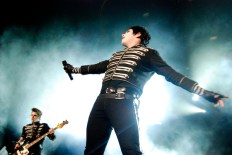
Tabling discussion on the merits of Nathan Williams’ discography, the idea of a given album being the record a band was put on this earth to make has always stayed with me, and I don’t think there’s a truer instance of it than with My Chemical Romance’s 3rd album The Black Parade, which turns 10 today. That it’s the band’s best album is a foregone conclusion; it’s also their best-selling (double platinum in the US and UK, platinum in 5 other countries), the purest distillation of their essence, and it still has a cultural footprint. Go to a theme park for a day, and you’ll still see at least one kid sporting a My Chem shirt with that marching band skeleton on it.

And that marching band skeleton matters because aesthetic has always counted for a lot (like, a lot) for My Chemical Romance. It’s largely immaterial that their heavy makeup look, red and black wardrobe, and campy horror/sci-fi overtones borrow heavily from The Misfits and horror punk/’80s goth in general, the point is they adapted it with near perfection for the MySpace generation with 2004’s Three Cheers For Sweet Revenge. As that album caught on, more and more scene kids started getting into ornate all black outfits and black fingerless gloves. You can even see MCR’s immediate impact on their contemporaries’ aesthetic: Fall Out Boy look like normal dudes in a band for their “Sugar, We’re Going Down” video, MCR’s highly stylized/Tim Burton-ized/choreographed video for “Helena” comes a month later, and suddenly someone’s giving FOB’s extras dance lessons and bought Pete Wentz some eyeliner (side note: FOB’s lowkey careerism is almost inspiring). By 2006, MCR lead singer Gerard Way was responsible for more eye makeup and black hair dye than Billie Joe Armstrong.

usrev0600227_640x480_01It was a surprise, then, when Way first appeared bleach blond, and with the band in matching marching band uniforms to ring in The Black Parade era. The “Welcome to the Black Parade” video was a blindsider: this band had sounded and looked more or less true to life before, but here they are leading a parade as Sgt. Pepper’s Lonely Death Cult Band that is supposed to guide someone to the afterlife? And Way bleached his hair to become the album’s protagonist The Patient, who is dying of cancer? The song itself was a change-up, too; these scuzzy, former hardcore punk kids were back with a polished song that dared include a piano introduction, martial drumming, and downright Queen-esque guitar solos. “Welcome to the Black Parade”–all 5 minutes of it–was stock pop-punk underneath it all, but the clarity of execution and grander scale caught lots of fans off-guard. Way had telegraphed this, though, in an interview the year before by saying that MCR was patterning their career after The Smashing Pumpkins, that the first album was discovering their sound, the second was refining it for a broader audience, and the third would be actualization.
Now, as a Pumpkins lifer and My Chem casual, I feel like Way compared my favorite album ever to a decent if filler-heavy record just to one day piss me off, but after the fanrage subsides, I admit there’s something to equating The Black Parade to Mellon Collie and the Infinite Sadness. They both lead with quietish intro tracks that segue into explosive numbers, and in spite of both records being the most stylistically diverse that each band got, they’re incredibly front-loaded with straight ahead rockers whose momentum crests with lead singles. Each gets deliberately kooky in their back half, which sees the band do some of their quietest and loudest work, although Billy Corgan never thought to have a Liza Minnelli cameo buried in with his heavy metal histrionics. But, more than structural similarities, what Mellon Collie and The Black Parade share is an expansive, edge of the world ideology. You can hear each band push every idea they have as far as possible on these albums. Wanna do a slash and burn power ballad? Okay, here’s “Sleep.” Three Cheers-style, bashed-out wailers? Enjoy “The Sharpest Lives.” Not only does My Chem lean into their theatric side with the cabaret of “Mama” (hi, Liza!), but they mash it up with Iron Maiden worship, too. And “Teenagers” isolates the strands of sarcastic, stooge-y (and Stooges-y) DNA in the band’s composition.

Just as the Bald Man justified Mellon Collie‘s scope by calling guitar rock passe, MCR’s Queen, Pink Floyd, Bowie, and Beatles influences on The Black Parade can be explained at least in part by the band trying to get as far afield from the “emo” tag as possible. This ended up being a right place/right time move: in hindsight, 2006 is the line in the sand between the cathartic, hard-charging stuff of the emo breakthrough and the poppier, less engaged (read: shittier) dance-influenced stuff that would eventually devolve into scene-pop. Similar to how My Chem distanced themselves from emo with classic rock on TBP, FOB would go further into arena rock and soul, original breakthrough acts like Taking Back Sunday and Jimmy Eat World spent the mid to late ’00s making “mature” records, and even carpet baggers Panic! at the Disco laid low in their own Sgt. Peppers’ disguises for their next album. Gerard Way would eventually take things even further by declaring emo to be “A pile of shit” in a post-Black Parade world.

462546998_31f9ee2354_oEven if not everything on the album works, an awful lot of it does. Opening on a The Wall-inspired note with “The End.” and launching into the zany “Dead!” is MCR’s most satisfying one-two, “House of Wolves” is a still a reliable venom spitter, and “Sleep” is a one-up on Three Cheers‘ “The Ghost of You.” “Mama” might be the most off-kilter thing on here and thrives because of it, and I like the string and piano ballad “Cancer” so much that not even an abysmal Twenty One Pilots cover can sink it (second side note: my reaction to Twenty One Pilots covering MCR shouldn’t be “Huh, this needs to be more melodramatic and obnoxious,” but here we are). “Cancer” works so well because it conveys how tortured and shriveled The Patient is through the writing and performance, not blustery volume; as far as macabre lyrics go, it’s hard to top “Baby, I’m just soggy from the chemo.” Elsewhere, the not-quite-filler stuff like “This Is How I Disappear” or “Disenchanted” still sounds fine due to Rob Cavallo’s production.
You can tell The Black Parade is the album My Chemical Romance was put on this earth to make, not just because it’s a culmination of everything they’d done before, but because they had such a hard time following it up. The band originally planned on a hard and fast follow-up recorded with rock producer Brendan O’Brien, but those sessions were shelved due to the band’s dissatisfaction with the end product. After scrapping more material, Way started working in January of 2010 on what would be released that fall as Danger Days: The True Lives of the Fabulous Killjoys, a concept album about desert renegades fighting against a corporate dystopia (10 songs from the O’Brien sessions would be later released as a compilation album). Taking the The Smashing Pumpkins’ comparison further than Way intended, MCR never made their “falling from the peak in slow motion” record ala Adore, but Danger Days is definitely their Machina: the flailing, end of the line, rawk album unaware of its own desperation. MCR would break up in 2013 without another proper record.

I haven’t heard any chatter about Danger Days since its release, but The Black Parade ended up making waves again earlier this year. A teaser video of sorts went up on MCR’s YouTube page in July, and immediately the internet went wild with speculation over a possible reunion tour. In the end, the teaser was for a not especially interesting looking TBP special edition that came and went without much other promotion, but the instant hype around even a potential tour proved this band and this album resonated with a lot of people, and it still does. I get why: it’s a melodramatic rock album with camp for days, and perfectly tailored for anyone whose ever felt angsty and grandiose, and kids will never stop being part of that parade.

Posted in "Thoughts" | Tagged , , , , , | Leave a comment

Album Review: Bon Iver – 22, A Million

The best song that Bon Iver/Justin Vernon is essential to isn’t called “Skinny Love” or “Perth,” it’s called “Lost in the World.” The penultimate track on Kanye West’s still kinda bonkers My Beautiful Dark Twisted Fantasy generously samples the melody and phrasing of Bon Iver’s 2009 song “Woods,” going so far as to use the song itself as an introduction before shooting Vernon’s somber, Auto-Tuned falsetto into outer space, but with more processed choirs, massive drums and thundering piano. Reaching the end of MBDTF is kind of exhausting, but “Lost in the World” is worth the trip in significant part due to that “Woods” sample because without it, there’s nothing for the rest of the song to build and play off of.

“Lost in the World” also unintentionally shores up what bothers me about Bon Iver: Vernon is undeniably talented at folksy auteur studiocraft, but what he actually does with it is frustratingly limited. For how sculpted his music sounds, it often comes off as inert, and frankly too dull to mine for pathos. The, let’s call it “interest gap,” between “Woods” and “Lost in the World” illustrates this perfectly: “Woods” delicately stacks various AutoTuned voices repeating its lone stanza, but after 3 minutes of sad-man falsetto with nearly 2 more to go, I feel Vernon’s melancholia less and my own indifference more; I just want to hear someone’s ego obliterate and reconstruct itself over Gil Scott-Heron samples, blaring alarms and poems written to Kim Kardashian.

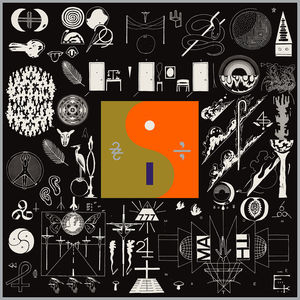
I feel like Vernon gets this. In case the insular song titles, wacko name, and “I’m really getting into numerology” cover art aren’t a tip-off, 22, A Million is Bon Iver’s self-conscious freak-out album. And at its best, it sounds like a deconstruction of the folk and 80s soft-rock mash-up that Bon Iver went for on Bon Iver, Bon Iver. Here, Vernon slathers the instrumentation and voices on the album in gauzy, grainy production and foregoes verse-chorus-verse structure. Instead, songs drift into each other when they don’t start or stop without warning, and different elements like guitars, saxes, or vocals add to the chaos by suddenly reappearing/disappearing. The intention is to sound dissociated and non-linear, even though loopy instrumentation, obfuscated singing, and a blaring mix like this are all stock maneuvers from the Indie Rock Kar-razy Record playbook.

But shit, sometimes the playbook works. “10 d E A T h b R E a s T ⚄ ⚄” is built on a delirious drum loop, heavily Auto-Tuned vocals, too loud synths and horns, and backwards guitar like someone smashed Revolver and 808s & Heartbreak together as hard and loud as they could, and is downright exciting because of it. It shows Vernon operating as far on the musical fringe as he’ll allow himself to on a Bon Iver record, but succeeds by doing so. Opener “22 (OVER S∞∞N)” with its warm tape hiss, bright guitars, and gospel vocals on top of Vernon’s falsetto, sounds like a glitchy, pretty sunrise. Elsewhere “33 “GOD”” is 22, A Million‘s take on Bon Iver, Bon Iver‘s stately studio folk, injecting the latter’s grandeur with looseness and spontaneity that lets it soar higher. It’s delightful enough that I wish the song went longer instead of cutting off at 3:33 cuz numbers, man.

At other times, 22, A Million‘s choice to fire weird doesn’t work in its favor. Vernon’s engineer Chris Messina invented a new AutoTune harmonizer that gets used on acapella track “715 – CRΣΣKS,” which works for a panicked, broke down lyric like “Goddamn, turn around now,” but is otherwise insufferable on a track with a weak melody to begin with. “____45_____” uses Messina’s device on a saxophone that plays opposite of Vernon at his most natural, and while “Man sings opposite vocoder sax and banjo” sounds neat conceptually, it’s a lot less engaging as a listen. That “____45_____” follows the tedious “8 (Circle)” only hurts things since “8 (Circle)” represents the album at its worst: it’s a ruthlessly mid-tempo, sax-heavy, 80s cheese-rocker with layers of hazy mixing that barely goes anywhere. “8 (Circle)”‘s 5 minute run time feel like–well–8.

22, A Million‘s peaks and valleys flatten out over time. Although “SHAD Apartments” is engaging in fits and starts and “666 f” has interesting moments, they never gel as songs, and just sound half-baked. “21 MOON” is too committed at synth-inspired, soundscapey background texture for its own good, and after a tepid 2nd half, closer “0000 Million” comes off as a wash. The most damaging part of these back-half misfires is that they come on the album’s longer songs (both “SHAD Apartments” and “666 f” flail about for 4 minutes apiece, which yikes) and at a brisk 34 minutes, 22, A Million doesn’t have space to surrender this much of it to the doldrums.

I don’t imagine Vernon meant for 22, A Million to sound contemporary in 2016, but it does. If you’ve put together a knotty, high production value, sprawling album that reads as a nonlinear monologue (or a dialogue!), 2016 is apparently your year. You could name Kanye’s The Life of Pablo and Blood Orange’s Freetown Sound here, but the albums that 22, A Million remind me most of are Frank Ocean’s Blonde and It’s the Big Joyous Celebration, Let’s Stir the Honeypot by Teen Suicide.

Blonde and 22, A Million‘s main difference is genre: outside that, they’re both long-gestating, isolationist albums that emphasize studio tinkery and stubbornly/frustratingly (YMMV) refuse to give into the pop instincts they tease out. I spent a month obsessed with Blonde despite the fact that you could level most of my criticisms of 22, A Million at it–that it’s stodgy, its drumless tempo approaches glacial at times, and it’s abstract to the point of formlessness. But Blonde, for me, works because it has songs: “Nikes,” “Self-Control,” and “Nights” have presence and melodic deftness, and no matter how (warning: overused music crit vocab incoming) ethereal Blonde gets, the songwriting, composition, and mixing are all solid. 22, A Million, meanwhile, gets lost in its own inscrutability.

It’s the Big Joyous Celebration…is 26 songs of low-fi indie rock/bedroom pop that comes to just over an hour (think of it as Mellon Collie and the Infinite Soundcloud), but reminds me of 22, A Million in its vignette styling, lyrics that seem like inside jokes with themselves, and how it uses garbled production to let itself be vulnerable; something looping and frayed but hopeful like “I Don’t Think It’s Too Late” could fit on either album. But Teen Suicide is willing to go for it in a way Bon Iver won’t; Vernon, as shown on the album’s back half, never strays from his folksy, plainspoken but kind of pedestrian approach to songs. Even dressed up in production tricks, vocoders, and numerology, these songs are just too nice to be as challenging and therefore rewarding as they want to be.

For its ideas, some truly great songs, and inspired moments, I’d say that 22, A Million is Bon Iver’s best album, but that doesn’t mean it avoids its predecessors’ pitfalls. Vernon, for all of his inventiveness, insists on too many feints and too little directness to make an end-to-end engaging record. He even pulls up short on this album’s weirdness; a weirdness whose “a band, but deconstructed” approach is only truly surprising if we act like Kid A isn’t a founding document for modern indie. Which is a shame, because 22, A Million is fulfilling when it uses unconventional sounds and structure to build toward something, and far lousier far more often when it’s content to mill about and make oblique references to God or relationships or whatever. The philosophical guts of the record borderline inaccessible if the music just isn’t there. If you’re all in on Bon Iver and Vernon’s music emotionally, then it can be a sweeping, mesmerizing trip through his head and yours. To the rest of us, he just sounds lost in the woods.

Posted in Album Reviews | Tagged , , , , , , , | Leave a comment