Radio Rant: Ed Sheeran – Thinking Out Loud AND Maroon 5 – Sugar

Hello, and welcome to Radio Rants. Let’s thaw out today.
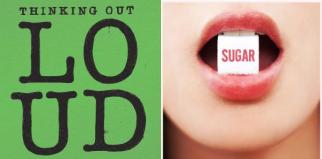
LoudSugarLooking at a double-header today because I’ve been seriously slacking on the radio hits. There’s been a lot of exciting music in the first quarter of 2015–there are already at least three albums that could argue for a spot in my top ten–but very little of that excitement’s translated to mainstream pop, or at least the charts. I still love “Uptown Funk”, but I’m ready for a new zeitgeist. So, let’s look at the two songs that spent a month trying to dethrone it.

First up, for no more discernible reason than I thought of it sooner, is Ed Sheeran with “Thinking Out Loud.” I’ve ragged on Sheeran before for writing bad songs, but I respect him as the British Bruno Mars: he might not always have A1 material, but he’s a solid performer who’ll sell the shit out of anything. Granted, it’s a lesser level of respect because Sheeran’ll never make me lose my shit the way this did, but still, any guy solo act that can notch multiple hits these days is doing something right. Probably. To other people. I still stand by “Don’t” and “Sing” being awful.

The biggest challenge facing “Thinking Out Loud”, meanwhile, is that it’s “Let’s Get It On” stripped to the essentials. That’s not even me being reductive (for once). That slavish, kickass guitar riff that winds through “Let’s Get It On” has been replaced by stock “dorm room soul” guitar strums, while the strings and horns are absent in favor of piano fills that are kind of winsome, but nothing too lively. Gone too, is the life in the drums. And despite all that, “Let’s Get It On” and “Think Out Loud” are unmistakably the same damn song. You can drop one on top of the other in the laziest way possible, and watch two songs become one instantaneously. Sheeran’s probably thanking those thousand stars he can’t be sued for a chord progression.

All that Marvin Gaye rubs shoulders with a lot of John Mayer, too. Granted, this sort of chilled out, clean Fender strat, white guy blues is Mayer’s wheelhouse, but I heard that endearingly wanky guitar solo, and honestly thought this was a song John Mayer wrote to afford new guitar strings after no one bought Paradise Valley. I even checked the credits. But no, Mayer only shows up on the version at the Grammys, where he backs Sheeran with Herbie Hancock and Questlove in the most overqualified and underutilized supergroup ever (my suggestion: next time pair Quest and Mayer with Dave Chappelle; proven results). There’s something dissonant about seeing this much talent on a track that’s so simple. Sheeran wrote “Thinking Out Loud” as a straight ahead wedding tune; it’s “fuck me, I’m sensitive” dressed in a schmaltzy a tie and vest.

But, here’s the problem: I like that about it. Ed shimmying through a Pharrell demo, or preening like Adam Levine rubbed me the wrong way because it felt like a cheap radio move. But despite being a much simpler, kind of boring song, “Thinking Out Loud” hits its marks as a cheesy, kind of schluby wedding tune, and Sheeran absolutely sells the chorus. Lyrically, it burns through every woo-the-girl-at-the-coffeeshop cliche possible, but Sheeran performs the shit out of it; he knows what he’s doing. Not a song that’ll end up the year-end, but a nice singalong all the same.

Also joining us today after appearing on the Worst of 2014 list is Maroon 5. I honestly kind of thought these guys were, if not done, at least in a slump after “Maps” didn’t take off, but the back to back success of “Animals (mals)” and now “Sugar” have proven me wrong. They might not have the stranglehold on the charts they during Overexposed (“One More Night” was number one for a staggering nine weeks), but the cultural currency of Adam Levine and the Maroon 4 is still alive and well.

And I don’t think anyone’s as bummed about Maroon 5 still being around as Maroon 5. They’re not just boring, they even sound bored. Their most recent album V plays with all of the passion and zeal of an amusement park show choir slumming it through “Walkin’ on Sunshine” and “It’s Gonna Be Me” at an 11 AM Tuesday performance. And that same lethargy applies to “Sugar”.

“Sugar” gets points for this much: it’s head and shoulders above “Animals” and “Maps” on every level. Mostly that’s due to pop-soul being a lively genre with bounce to it even on cruise control, but it’s also Maroon 5’s ostensible wheelhouse; the more their rhythm section gets to strut around, the better. Even though it’s (relatively speaking) loose and breezy, “Sugar” is still just as by-numbers as you’d expect: the bass pops right where it’s supposed to, the falsetto kicks in like clockwork, and the chorus is head-tiltingly smooth. Any sense of groove or real musicianship is covered in a thick studio lacquer that sands the track down to the dullest form of soul possible.

If you want to hear an excited version of “Sugar”, look no further than Katy Perry’s “Birthday” (which itself is the child of Perry’s own “Last Friday Night” and Bruno Mars’ “Treasure”). “Birthday” is a less stifled, more colorful version of “Sugar” that isn’t afraid to be a little goofy, and is all the better for it. Sure, Levine wouldn’t sing something this stupid, but Perry wouldn’t sound as bored. The similarities between the two songs feel like more than coincidence: not only do they share a cowriter and producer in Dr. Luke and Cirkut and the same vamps, but their videos have the same premise of watching pop stars crash birthday parties and weddings and everyone’s just going to go with it.

Outside “Uptown Funk”, “Sugar” is the current hit that the most real life tangibility. It’s the one that’s made its way to playlists at diners, waiting rooms, shopping malls, gyms, and wherever else music is treated as a part of the background. This seems about right. This is the kind of song that’s best experienced where you can hear enough to appreciate it on the shallowest level possible; anymore than that, and the taste of aspartame develops. Calling this song “Sugar” is a bit of a misnomer: it might be sweet, but the taste is all artificial.

Posted in Radio Rants | Tagged , , , , , , , , , , , | Leave a comment

Album Review: Kendrick Lamar – To Pimp a Butterfly

One minute and thirty-six seconds. That’s how long it takes to get to the first rapped line on To Pimp a Butterfly. To even get there, you have to listen to a sample of a 1974 Jamaican soul song entitled “Every Nigger Is a Star”, George Clinton vocals, a tenacious Thundercat bassline, and Lamar singing a hook over a demented funk track. This is quite possibly the most anticipated rap album of the year, and actual rapping is one of the last of its elements you hear. No one said Lamar was going to make it easy for us.

Alright, so, perhaps not surprisingly given that his last record was a non-linear “short movie”, Kendrick Lamar wants To Pimp a Butterfly to be a lot of things. It’s his post-fame album. It’s his searching for a greater meaning album. It’s a celebration of Blackness. It wants to ask what being Black in 2015 means. It wants to be his self-consciously arty, genre and style hopping send-up to the past greats album. It wants to be Serious Art with a cohesive narrative guided by a poem that gradually builds throughout the album, but still a solid song-to-song listen. It wants to be impressive lyrically, technically, and musically.

Thank God it’s only 78 minutes.

The first thing most notice about the album is how deliberate it is in its sound. George Clinton, the founder of P-Funk, doesn’t introduce the album for nothing; there’s a lot of funk driving the record. But calling To Pimp a Butterfly a funk album is reductive and misleading: there are jazz cuts on the spectrum from the smoothness of “Institutionalized” to the freakouts happening in “For Free?” and “u”, flashes of disco, “Alright” leans into snare-heavy club territory, and more than a little psychedelic soul, particularly toward the middle of the album. It reminds me in a lot of ways of a fuller version of what The Roots were doing on undun and …And Then You Shoot Your Cousin: moody, live band-oriented instrumentals with a tendency to freak out, but unmistakably hip-hop to its core. It’s less dense than it is overwhelming; there’s a lot to listen to, like the way the “Alright” cheats a clarinet in during a verse, or the deft guitar licks in “King Kunta”. None of it’s really radio fare, but the same could be said about good kid, m.A.A.d city.

A big part of To Pimp a Butterfly‘s sound is just how damn rich it is. Each song is almost overloaded with how much it has going on, even something like “Hood Politics” that stays mostly in its lane starts with a bouncing funk beat. With the production values as high as they are–and the instrumentation as intricate as it is–this would be a fun listen just as an instrumental. The sound isn’t rich just in sheer quantity, but in how performed every little detail is. The back up singers on “King Kunta” play it up like a blaxploitation soundtrack, and the over the topness of Lamar’s drunken ranting during “u” would be corny in another context, but it fits the way the song falls apart underneath him.

Lamar pushes himself in different directions here as a rapper. At this point, he’s unarguably one of the most technically proficient mainstream rappers around; he could have dashed out a record of grinding beats into submission ala “The Blacker the Berry” and called it a day. But, tellingly, To Pimp a Butterfly‘s first single wasn’t “The Blacker the Berry”, it was the slippery, fleet-footed, multi-voiced “i”. Lamar uses an array of different voices on the album to convey a tone: he’s a broken mess on “u”, a squeaky younger version of himself on “Hood Politics”, a hood friend on “Institutionalized”, an incarnation of Lucifer named Lucy (long story) on “For Sale?”, and frequently plays off conversations with himself (see: “Momma”, “How Much a Dollar Cost?”). It’s actually a smart move; by playing up verbal tics, exaggerations, and occasionally doubletracking, Lamar by passes the fact that he still occasionally sounds gawky. And regardless of what voice he’s using, the technical abilities and flows still shine through, like the beat riding on “Wesley’s Theory”, the snarling on “King Kunta”, double time on “Momma”, rapid fire slam poetry on “For Free?”, or unrelenting lines of “Mortal Man”, he’s just a blast to hear rapping.

It’s also his lyrics that keep the narrative together. Lines occasionally get repeated (“What you want, you a house or a car/Forty acres and a mule, a piano a guitar?”), but most of the heavy lifting is done by a poem that intros or outros most of the songs. The poem adds a line or two during each iteration based on what songs it’s connecting, a move that mostly stays on the right side between interesting a tedious (it drops out just as the repetition starts to get grating on “Hood Politics”) before finally showing up in full on “Mortal Man”.

And honestly, if the album has a fault, it’s that it tries to cover way too much thematic territory in the ending interview with 2pac after “Mortal Man”. After spending the last seventy minutes laying groundwork, the album deploys its core “Black in America” thesis in a pair of poems that ultimately preach Black self-love and unity, but teeter close to respectability politicking at points. Lamar is, at the very least, aware that the message and/or its delivery are muddled; self-love jam “i” is here as a live performance (perhaps symbolizing the song’s message as an outward sign of inward goal) that is literally shouted down by a crowd (no small group has labelled Lamar as having a messiah complex, which is as hard to substantiate as it is to deny), and when he reads his final poem to 2pac symbolizing Black unity for Pac’s approval, his request is met with album-ending silence.

Even if it doesn’t quite stick the high-concept landing, To Pimp a Butterfly is an aggressively, fascinatingly Black album. A crate of surface references to wide noses, nappy hair, The Color Purple, Richard Pryor, Michael Jackson, colorism, racial policy at home and aboard, G-funk sounds, and gangsta culture populate the record. It’s an album about being Black and successful, being Black and depressed, being Black and on your shit, being Black and the constant tension of your Blackness being pulled and picked on by society, but being Black is at its very core. This record’s Blackness is invasive, almost as invasive as it is in Black lives. It’s the first album I’ve heard that I’m not sure I’d experience in the same way if I weren’t Black.

But, pulling back the reins here a second, let’s just examine To Pimp a Butterfly as an album. It is excellent. Even as Lamar’s ending ideas and executions trip over their own self-importance, they’re entertaining to listen to (Lamar does a great job reflecting 2pac affability when he interviews some of his back tapes), and the music, technical chops, and lyrics are all top notch. Regardless of who you are, anyone with more than a passing interest in hip-hop, soul, or jazz will finds a lot to listen to and appreciate here, and probably a lot to think about. Go check out it, five out of five.

tl;dr (but actually): To Pimp a Butterfly is a sprawling album that refuses to be lost in its own head, 5/5.

Posted in Album Reviews | Tagged , , , , , , , , | Leave a comment

Album Review: Marina and The Diamonds – FROOT

Marina Diamandis would enjoy her career so much more if she could just stop thinking about it.

She’s got the voice to make it happen, but her biggest weakness is that for as image obsessed as she is, she can’t help but let her seams show. I liked Electra Heart (a minority opinion) as a fun-if-overthought pop record, but I see where the chronic self-consciousness and occasionally rote songwriting caused it to slump. Diamandis is an artist driven by broad concepts, but lacks the finesse for execution; Electra Heart was an exploration of female identities in the corrupted, materialistic American pop landscape on paper, but in practice it meant getting songs like “Primadonna” about a primadonna, and “Homewrecker” about, well, what do you think? She can present concepts, but not develop them.

Of course, context didn’t help Electra Heart. Diamandis submitted her entry for “meta pop star” at the exact time the winking confections of Katy Perry, the self-aware sleaze of Ke$ha, and the pop art plasticity of Lady Gaga hit their sell-by. And then there was Lana Del Rey. Del Rey was a pitch perfect, show-don’t-tell version of the Electra Heart character Diamandis insisted she was (tellingly, a Venn diagram of the two’s fanbases is almost just a circle). Del Rey made “American trophy wife on white wine and Valium” look like it was why she was put on this Earth. You could always see Diamandis adjusting her pink bow.

All of this matters because FROOT is a conscious reaction to Electra Heart. After an album full of artificial personalities and big name collaborations, FROOT is an unadorned record made with a lone coproducer and Diamandis having sole writing/composing credit. It’s an introspective, “sometimes I need to be alone” album that doesn’t have an obviously trendy single, but instead wants to be a validated, artistic statement.

Just listen to opener “Happy”. As Diamanis sings “I found what I’d been looking for in myself/Found a life worth living for someone else…Never thought that I could be, I could be happy” backed by concert hall piano chords and gentle drumming, you can practically imagine her standing still in a spotlight while removing Electra Heart’s make-up and blonde wig. There are a few more themes at play here, too. FROOT‘s inspired by a break-up (where Diamandis was the breaker-upper), which gets its share of focus, but it’s not the heart of the matter, like Vulnicura or Sea Change. Instead, this album focuses on the self-affirmation, loneliness, and recovery that come afterwards; it’s about a break-up, but I’d hesitate to call it a break-up album.

You wouldn’t, for instance, have something like the title track on a break-up album. “Froot” is probably the best distillation of the album’s sound; a sleek blend of electropop filtered through a live band setting, where programmed loops and 8-bit effects with spacey synths bounce around a glammed out disco chorus with a killer guitar riff. Combined with some of Marina’s most restrained but sensual vocals, the resulting track makes something new by blending sounds she’s worked with for years (it was also the first song released for the album, back in November, and still sounds fresh five months later).

While nothing is quite as expansive or intricate as “Froot”, the record is frontloaded with poppier cuts. Single “I’m a Ruin” balances it’s pretty, reverb-drenched atmosphere with nimble guitar work and a great vocal take, then the album peaks early with the one-two punch of “Blue” and “Forget”. “Blue” finds most of its strength in a lilting synth hook, massive New Wave chorus, and surprisingly danceable rhythm section, all of which drive the cautiously optimistic lyric “I don’t want to be blue anymore” home. “Forget” picks up “Blue”‘s momentum, cuts through the reverb, and delivers the album’s biggest pop song. You listen to these, and get an idea of what a less radio-chasing version of Electra Heart might have sounded like.

Unfortunately, FROOT‘s sleekness sound hurts it later on. “Better Than That”‘s whirring synth, incessant bass, and yelping guitar are all overproduced, resulting in a messy track that sounds suffocating, even as Diamandis has some lyrical barbs. “Weeds” is a better composition, but its effectiveness as a pop ballad is limited by the production; the song wants to be an organic, sweeping ballad, but the mix is too cloying to let anything register. Likewise, “Savages”, with its lively piano and cultural critique, sounds like a deliberate call back to Diamandis’ first album The Family Jewels, but FROOT‘s too buttoned up for that sort of hysteric goofiness to work here. It’s not that these are bad songs, it’s just that they don’t play to the album’s strengths. Minimal electro-ballad “Solitaire” does, and is a standout for it.

Weak songwriting and clunky execution show up on FROOT, too. “Better Than That” gets into confused and overly complicated gender politics (she admonishes a woman up and down for using sex to get ahead, then has a lyric saying this isn’t slutshaming because she’s not judging the sex, but that this woman betrayed her. Disagree, agree, take your pick, but this is too much thought for a not-good song), and when she tries to do cheeky girl-power pop complete with a cry of “girl in the 21st century” on “Can’t Pin Me Down”, the end result is somewhere I swear Lilly Allen or Kate Nash did years ago. Likewise, it’s hard to appreciate “Gold” when I think No Doubt was doing this same vaguely reggae, summer pop trick.

FROOT is bookended by ballads. Closer “Immortal” feels every bit as stately and honest (and “Honest”) as opener “Happy”. Again, the break-up gets plenty of references, but you wouldn’t have to stretch to imagine her singing “I want to be immortal” and “I wanna live forever/Forever in your heart/And we’ll always be together” to her fans. “Immortal” is mostly held together by string inspired synths and a steady bassline, less peaceful than the piano of “Happy”, but more determined to move on. And even though FROOT isn’t a masterpiece, it takes steps in the right direction for an artist still finding her footing. Three and a half out of five stars.

tl;dr: FROOT is a solid pop album despite a few bad apples.

Posted in Album Reviews | Tagged , , , , , , | Leave a comment

You Should See Them Live: Will Butler and Cloud Nothings at Woodward Theater

Indie rock doesn’t come through Cincinnati that often, so when I saw that Will Butler and Cloud Nothings were playing at the Woodward Theater in the city’s Over the Rhine district, I immediately made plans to go. It’s been a few months since I saw someone live, and figured hey, since I’ve never been to Woodward, the whole thing’ll be a new experience, so why not?

Woodward was entertaining as a venue. It’s a smaller place, but very much a “venue” and not a “rock club”. Sure, it’s got a bar, stage, and a balcony, but there was an air of cleanliness and culture to it. My beer (they have a slew of Cincinnati craft beers canned and on tap) came in real pint glass instead of a plastic cup. The walls were white. Most of the shows I go to are in rock clubs that revel in their own grime, bars that happen to have a small upstairs/stage, or a stadium. Woodward was different, and kinda novel for it.

Anyway, the bands.

WILLWill Butler’s one of the multi-instrumentalists in indie rock juggernaut Arcade Fire (far right here, jumping between a synth and keyboard) who released his debut solo album Policy this past Tuesday. Policy–and Butler as an artist overall–puts a high value in off the cuff spontaneity and zaniness, both of which translated to his live show. For Butler and his backing band–a drummer and a pair of synth/keyboard players–the stage was almost a playground; everyone moved between synths, guitars, keyboards, and live drums/drum machine between songs. It’s entirely possible none of the ten song setlist (Policy in full, plus two songs from Butler’s project for The Guardian) used the exact same setup, which is pretty entertaining.
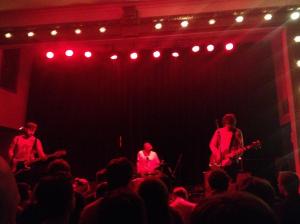
It helped that Policy is a live-friendly record. The punchier numbers like jangley, power chord workout garage rock strut of “Take My Side” and glammed up piano stomper “Witness” were there in proper form, and the slapstick standout rocker “What I Want” was made even more fun by hearing its wailing backing vocals and “I know this great recipe for pony macaroni!” live. But, the biggest two highlights came from where the live show deviated from the album: “Something’s Coming”, a shambling art-rock cut on the LP, found a deeper groove live, and between its heavy low-end and rhythmic vocals, veered into LCD Soundsystem territory. “Sing to Me” was still a somber piano number live, but added slash and burn synths and cymbal crashes over its climax, a surprising but satisfying way to finish the night’s most low-key moment. It’s not super likely Policy is going to end up on a lot of year-end lists, but a copy ended up in my hands that night, and it isn’t leaving rotation anytime soon.

CloudNothingzCloud Nothings are a Cleveland (yay Ohio! Boo Cleveland!) trio who I’m honestly beating myself up for not investigating before. They’ve been on my “list of bands to check out” since their widely regarded album Attack on Memory, and I finally caught up with last year’s Here and Nowhere Else during year-end listings. The band specializes in loud, fast, cathartic rock songs whose hallmarks are dynamic guitar riffs (as seen here) and high-cardio drumming. The band’s set started with “Now Here In”, and they blasted through most of Here and Nowhere Else and Attack on Memory with barely so much as a pause between songs. Dylan Baldi stopped once to thank everyone for coming instead of watching Empire (yay Empire! Boo most other Fox shows!) And the material and performances were strong enough that there was basically no need to throw off the momentum; why pause between “Quieter Today” and “Pattern Walks” any longer than the last chords need to ring?
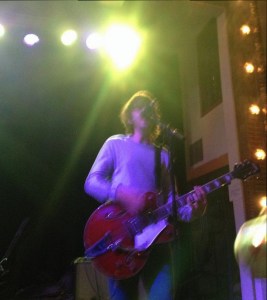
KloudNothngsTrying to parse the differences between Cloud Nothings’ live set and how the songs appear on the albums feels like a trite exercise. I’m not enough of a gearhead to get into the particulars, but it sounds like the rig guitarist Dylan Baldi used to record Here and Nowhere Else has become his live one, as well; the album’s wiry, fuzzy gnarled sound ran through Woodward, whether the song was “Giving Into Seeing”” or the band’s (relative term here) big hit “Stay Useless”. The only difference was a beefed up sound the Attack on Memory cuts, and maybe more graceful dynamic jumps on stuff like “Psychic Trauma”.

The undisputed highlight of the night was “I’m Not Part of Me”, hands down Cloud Nothings’ best song, and the one that got everyone in the theater moving. It was the moment where the night’s frantic, dashed together rock and roll hit transcendence, and life felt kind of complete for a bit while you and strangers screamed “You’re a part of me!” in each other’s faces. It felt jubilant. And so, while this was my first time at a new venue with a pair of artists I hadn’t seen before, I sure wouldn’t mind going back. Maybe get one or two more local beers. Emphasis on “one or two”, though; shit’s pricey.

Posted in Uncategorized | Tagged , , , , , , | Leave a comment