The Swift Sixteen: A Tournament of Taylor Swift’s Biggest Hits (part 2 of 2)

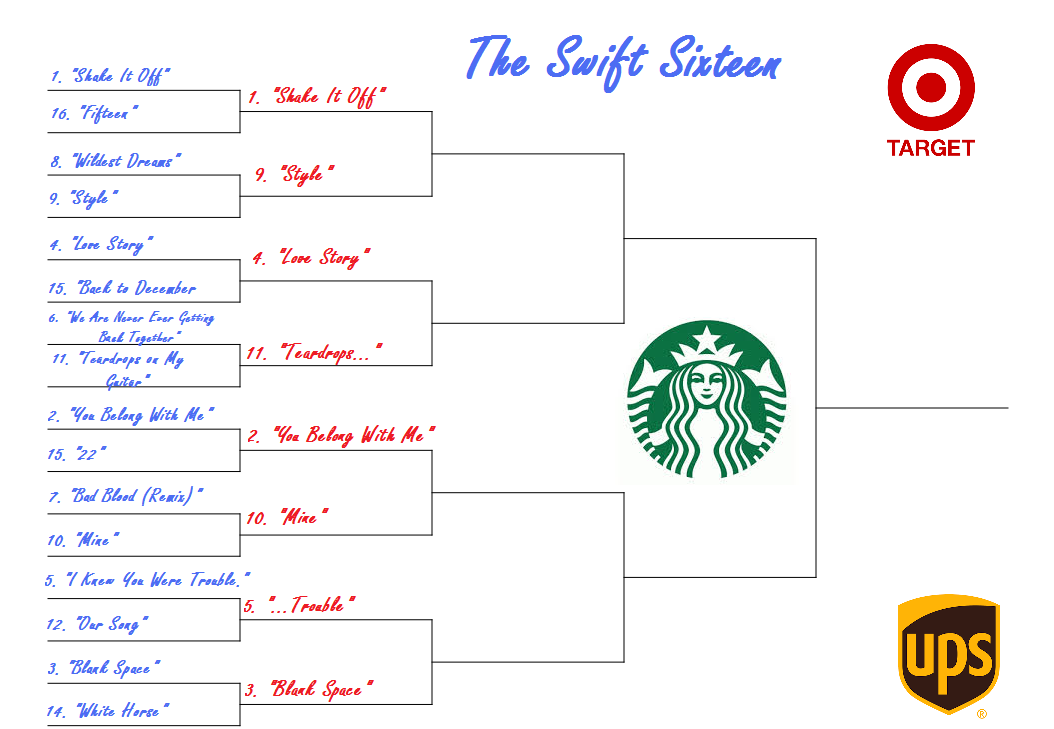
Here are the results of Round 1.
Let’s being Round 2!

Round 2, Match 1: “Shake It Off” (#1, from 1989) vs. “Style” (#9, also from 1989)
Twenty years from now, when Teen Jeopardy! needs a $400 answer in “Finish the Lyrics,” that sucker’s going to read: “This 2014 song cautions that ‘The haters gonna hate, hate hate/And the fakers are gonna fake, fake, fake’” and some nervous kid with too much hair is gonna say “What is ‘Shake It Off’?” while sucking spit out of their retainer. “Shake It Off” is guaranteed to be at least one of Swift’s two most enduring songs, and for an artist as careerist as she is, that gives it no small amount of weight. I remember seeing the video for the first time, and recognizing how it grabbed from different aesthetics, uniting them all under Swift. The intent was clear: Taylor Swift was making pop, and she was making pop for everyone.

And yet, “Shake It Off” is limited in its pull for everyone; it’s a song that could be sung by anyone. “Style” keeps all the pop trappings in that pulsating beat, the synthetic kick drum, and that soaring chorus, but there’s also real poignancy in the lyrics, too. It’s both a pop creation and a Taylor Swift creation. I realize that I’m talking about a single from what’ll be a defining mainstream pop album of the 2010s, but it feels like this song didn’t chart high enough. “Style” prevails in the upset to go to the Final Four.

Round 2, Match 2: “Love Story” (#4, from Fearless) vs. “Teardrops on My Guitar” (#11, from Taylor Swift)
Even though it’s only an 11th seed here, “Teardrops” is Swift’s biggest hit from her self-titled, making this the oldest possible Country Taylor match. And “Teardrops” handily wins, because “Love Story,” while a great radio single, retrospectively lives all the way under “You Belong With Me.” Plus, not that my opinion sways a lot here, but “Teardrops on My Guitar” kicked off my favorite Taylor Swift sub-genre: helplessly watching everything pass you by (see also: “The Story of Us,” “I Wish You Would”). “Teardrops” makes the Final Four.

Round 2, Match 3: “You Belong With Me” (#2, from Fearless) vs. “Mine” (#10, from Speak Now)
A few paragraphs ago, I said that “Shake It Off” was guaranteed to be one of Swift’s two most enduring songs. Its counterpart is “You Belong With Me,” an absolute monster of a song that has serious pathos in addition to being one of Swift’s catchiest hits (just try not to singalong to “So why can’t you see-eeeee-eee?”). “Mine” could maybe chase down a win against any of the other Fearless singles, but “You Belong With Me” is just too solid and quintessentially Swift to lose. To invoke another March Madness archetype, this is that game where the unassuming low-seed that clawed its way this far gets tossed into the sun. “You Belong With Me” belongs in the Final Four.

Round 2, Match 4: “I Knew You Were Trouble.” (#5, from Red) vs. “Blank Space” (#3, from 1989)
The second round ends with a clash of the titans. Both “I Knew You Were Trouble.” and “Blank Space” were their respective albums’ flagship singles: not the leads, but the ones that eventually defined the era. “I Knew You Were Trouble.” proved that Swift could hijack a contemporary trend for her own end. This marked a departure from “We Are Never Ever Getting Back Together,” which was fairly down the middle as far as radio sounds went; the only risk involved was that it wasn’t even country in passing. But CMA sweetheart Taylor Swift throwing dubstep drops into a single? That easily could have backfired.

Okay, so as I’ve mentioned before, I don’t really like “Blank Space,” but even I remember thinking, “Yeah, this is happening” when it started taking off in late 2014. “Shake It Off” might have broken the ice for Swift’s “first official documented pop album,” but “Blank Space” was what proved that she had pop staying power. It quickly eclipsed “Shake It Off”’s stint at the top of the charts, and solidified her arrival at pop’s center. “Blank Space” also marked, somehow, a new high in Swift’s popularity since it and its whip-smart video didn’t just look at Taylor Swift, Actual Person, but confronted Taylor Swift, Media Construction, blurring the two into one, self-aware reflection (if you squint, this is also where the road to Reputation begins). A few dubstep drops ain’t got nothing on that, as “Blank Space” rounds out the Final Four.

Final Four: “Style” (#9), “Teardrops On My Guitar” (#11), “You Belong With Me” (#2), “Blank Space” (#3)

Round 3, Match 1: “Style” (#9, from 1989) vs. “Teardrops On My Guitar” (#11)
And so one Cinderella run has to come to an end, but which?

“Teardrops On My Guitar” got here by being one of Swift’s best bedrock songs, while “Style” is exemplary of her, well, style. It’s a match of potential vs. actualization. “Teardrops” is great, but it’s limited by the fact that Swift is still figuring things out; it has all the right pieces, but isn’t quite realized. “Style” has a confidence and grace that’s missing from “Teardrops,” and just about every aspect of the former lives in bolder color than the latter. The instrumentation is richer, the lyrics are more complex, and it’s like night and day with Swift’s vocals between the two (it’s those swells at the end that really put it over the edge); in terms of composition, it’s hard to argue against “Style.” And the pair almost exist on a continuum: “Style” might be the cooler, older version of who she was on “Teardrops,” but both get denied because of some impossible to know other girl who almost pushes them into breaking. I think that kind of continuity is neat. “Style” is one of Taylor Swift’s best hits.

Round 3, Match 2: “You Belong With Me” (#2, from Fearless) vs. “Blank Space” (#3, from 1989)
Our first round 3 match was a battle of the underdogs, so of course, the other match is a tussle between dominant 2nd and 3rd seeds.

Let’s change our approach for a second and consider a hypothetical. Let’s say Taylor Swift isn’t Taylor Swift. Let’s say her career’s the same through Fearless or Speak Now, but the whole VMA debacle never happens, so she’s never thrown into a national pop culture controversy, so she remains a very successful country artist, but not someone whose profile reaches the point where Taylor Lautner tries spin-kicking the head off of Kanye West mannequin twice while defending her honor in an SNL monologue before settling for a measly punch (this is one of those sentences that sounds made up, but I swear to God it isn’t). And, let’s say that she never tries the pivot on Red, more or less sticking to country. She’s still noteworthy, but falls into a holding pattern after Speak Now where she notches a mid-tier crossover hit or two per album that gets bounced by the newest Selena Gomez or Imagine Dragons single.

In this hypothetical, “You Belong With Me” remains her commercial high-point, and eventually gets a “We Need to Talk About Taylor Swift’s ‘You Belong With Me’” gif-heavy piece in Buzzfeed in 2018 because that song’s a success no matter where you place it. Even if Swift never did anything else, “You Belong With Me”  endures because it immediately zaps everyone who hears it back to some personal memory they have with either the song or the situation described therein.

On the other side, “Blank Space” is still a creative and commercial achievement, but everything great about it hinges on Taylor Swift being Taylor Swift. It’s too dependent on context to reach that topmost level, and truth be told, Swift is at her most hit and miss when the songwriting relies too much on Max Martin’s melodic math. “You Belong With Me” is less sculpted, but more enthusiastic, altogether better, and in fact, “You Belong With Me” is one of Taylor Swift’s best songs.

FINAL ROUND: “Style” (#9, from 1989) vs. “You Belong With Me” (#2, from Fearless)
Alright, main event time. In one corner, we have a quietly impeccable synth-pop tune from 1989 which has toppled that record’s biggest single, and KO’d one of Swift’s earliest hits to get to the final. Against that is a song that could be said encapsulates Swift’s artistic essence during her country days, and quite possibly her most famous creation.

“Style” is the sturdier of the two, but “You Belong With Me” is Swift’s best earworm, so it’s musically a draw, and “You Belong With Me” runs laps around 1989’s least successful hit on every commercial and impactful level. That gives it an edge going into the final question: which song just does more?

And that’s where “Style” shines. “You Belong With Me” is universal, yes, but that’s because daydreams are. The phrase “you belong with me” is a thing you say when there is exactly a 0% chance of you two getting together, and the song cops to that; the lyric “Dreaming about the day” is arguably the quietest part of the song, but it’s still there. It’s a daydream content to be a daydream. Meanwhile, “Style” describes a complicated “will it work, or won’t it?” Swift has with a guy where everything they do gets tangled up–both sides admit they’ve been with someone else, but they keep coming back for each other because they just feel so good together.

But it’s not that simple, right? No one gets as invested as Swift is on “Style” over something that just works because it’s fun: it could be that you two stay together because it’s easy, or because you like the rush, or way you make each other feel in spite of all the baggage that comes along. Yet the song chooses to believe that it all works because of James Dean eyes and classic red lips. That’s every bit as fictional as “You Belong With Me,” but “Style” knows that. It knows that it’s grasping onto superficial reasons to avoid hard questions and the fallout of crashing down, and because of that, “Style” wants itself to be real more than anyone else. It knows what longing and–this is important–loss feel like, but it also knows that picturesque love stories don’t always work, which is why it desperately wants to believe that this supercut of romance can be true just once. “Style” goes in several directions, and is compelling in each one, so “Style” is Taylor Swift’s best song.

CLICK HERE FOR FINAL BRACKET.

Ranting Research Notes
-That “with some indie record that’s much cooler than mine” lyric in “We Are Never Ever Getting Back Together” lands a whole lot different now, considering how concerned with “cool” Swift’s next two records would be.
-It took doing this tournament for me to realize that “Our Song” and “Love Story” aren’t just the same song.
-Did anyone lose in the Twilight series as hard as Taylor Lautner?
-Speaking of Lautner: could you imagine what would happen if Swift ever got “Kanye in ’09” level backlash? She made Reputation after like, half a week of Twitter jokes; I think she just kills everybody if the backlash ever goes that far.
-A note on the pros and cons of song selection/seeding methodology: I wanted to use something objective, and considered a few different methods to keep things equal, but any number-based system was going to favor “22” at the expense of like, “Tim McGraw.” I went with Billboard in the end because their chart contains the least amount of weirdness–there’s no differentiating between pop versions and deluxe versions and such, nor would the earlier songs be at disadvantage because of being uploaded to Vevo years after their release. That said, Billboard still wasn’t perfect, since video performance was included and likely boosted some songs (looking at you, “Bad Blood”), and wasn’t present for others (“You Belong With Me”). Still, though, for someone as invested in cultural dominance as Swift, it got the job done.
-Yes, I’m reviewing Reputation, and soon.

Posted in "Thoughts", Lists | Tagged , , , , , , , , , | Leave a comment

The Swift Sixteen: A Tournament of Taylor Swift’s Biggest Hits (part 1)

Let’s look at the closing chunk of Taylor Swift’s “Look What You Made Me Do” video. When all of the Old Taylors were falling like Valkyries, it made me realize how many different eras Swift has, and how each is its own self-contained thing. And from there, I had a thought: if you pitted all of Taylor Swift’s biggest songs against each other, which one comes out on top? What would a March Madness-style tournament of Swift’s biggest pre-Reputation hits look like? So, that’s what we’re going to find out today, but we need some parameters before we begin.

Qualifications: Only songs that are on Taylor Swift albums can participate, and since the Reputation era is ongoing, songs from it do not qualify. If “I Don’t Want to Live Forever” couldn’t hack it on a T.Swift record, it can’t hang with “Love Story” here. Nor do Taylor Swift features count, so we’re also nixing that song she did with B.o.B.

Metrics: Each match is going to be decided by which song has the stronger argument for it being better, and the impact of each song at the time, plus and its impact going forward. My personal taste matters, but it only as far as an argument can take it. And to keep things objective…

Seeding: Seeding and selection were done using Billboard’s list of Taylor Swift’s biggest hits. This way, I have zero input into the matches and seeding, but it also means we’re robbed of deeper cuts like “All Too Well,” “The Story of Us,” “Mean,” “I Wish You Would,” and “Haunted” that will have to play in the NIT of my heart. Going off Billboard’s list, here are our seedings.

  1. “Shake It Off”
  2. “You Belong With Me”
  3. “Blank Space
  4. “Love Story”
  5. “I Knew You Were Trouble.”
  6. “We Are Never Ever Getting Back Together”
  7. “Bad Blood (remix)”
  8. “Wildest Dreams”
  9. “Style”
  10. “Mine”
  11. “Teardrops On My Guitar”
  12. “Our Song”
  13. “Back to December”
  14. “White Horse”
  15. “22”
  16. “Fifteen”

And here is the bracket:

 ARE YOU READY FOR IT?!

Round 1, Match 1: “Shake It Off” (#1, from 1989) vs. “Fifteen” (#16, from Fearless)
We’re off to a fiery Pop Taylor vs. Country Taylor start here in the first match. “Fifteen” is an almost storybook tale of what being in your freshman year of high school feels like, complete with making new friends and experiencing crushes. “Shake It Off,” meanwhile, is about Taylor Swift not just crossing over to pop, but leaving country in the dirt.

As far as song quality goes, it’s about a tie. “Shake It Off” has always been mindless but catchy, and “Fifteen”  is the least essential of the Fearless singles because it feels like a rehash of what Swift did on her debut. It comes down to impact. “Fifteen” was a hit, but one that’s always existed in “Love Story” and “You Belong With Me”’s shadow, while “Shake It Off” still stands as Swift’s pop music coronation. It set the stage for her world dominating 1989 cycle, was the culmination of four albums’ worth of planning, and stuck the landing. “Shake It Off” advances in a blow out.

Round 1, Match 2: “Wildest Dreams” (#8, from 1989) vs. “Style” (#9, also from 1989)
After leading with one of our most lopsided pairings, the second match is probably the tournament’s most even coupling. “Style” and “Wildest Dreams” were 1989’s 3rd and 5th singles, and were the ones that were just kind of there, relatively speaking. Neither went to number 1 on the Hot 100 (“Style” peaked at 6, “Wildest Dreams” at 5), nor were their videos Earth-shattering events like “Shake It Off,” “Bad Blood,” or “Blank Space.”

These songs are both The Sexy One, so this match gets decided by which does that better. “Wildest Dreams” has more risque lyrics (“His hands are in my hair/his clothes are in the room”), but that pulsating beat and Swift’s delivery nail what being enraptured with someone is like, plus that “he’s got ____/I’m ____” chorus is Swiftian to its core. Were this tournament actual March Madness, this would be that game where no one expects much from either team, and then the winner hangs like, 35 extra points on the loser. “Style” advances in a rout.

Round 1, Match 3: “Love Story” (#4, from Fearless) vs. “Back to December” (#13, from Speak Now)
And so we come to our first county vs country throwdown of the tournament with “Love Story” from Swift’s 2008 breakout record Fearless squaring off against “Back to December” from its 2010 follow-up, Speak Now. The most interesting aspect of this match is that “Love Story” is one of Swift’s most mercenary singles, while “Back to December” comes from her least radio-friendly album. Not that Speak Now is radio-unfriendly–Lady Gaga’s Joanne was more obtuse–but within Taylor Swift’s oeuvre, it’s not artisan synth-pop, a country-pop smart-bomb, or a genre-hopper where every song could be The Single. Instead, Speak Now is her most writerly record; the one where she wrote almost everything solo and handled coproduction with longtime collaboration Nathan Chapman while refining what made a song a Taylor Swift song. You can hear her tease an idea out, play around with it, and move on once everything’s lyrically come full circle.

All this is to say that Speak Now makes for as solid as any Swift record as a whole, but tends to come up short on a song to song basis, let alone going against a song that goes for the pop jugular like “Love Story.” You could make an “artistry vs. commerce” argument here, but it’d rely on an even match. As is, “Love Story” is ruthlessly efficient, while “Back to December” just reminds me of Speak Now‘s lesser qualities: it’s overworked and too long. “Love Story” handily wins it.

Round 1, Match 4: “We Are Never Ever Getting Back Together” (#6, from Red) vs. “Teardrops on My Guitar” (#11, from Taylor Swift)
Here’s our first landmark match up! “We (eee!) Are Never Ever Getting Back Together” is, as I’m sure you know, Swift’s first overt move toward the CMA side door, while “Teardrops on My Guitar” was her first Top 20 hit. “WANEGBT” puts a lot on the board: it went platinum six times, was her first collaboration with pop braniac Max Martin, and was her first number 1 hit in America. The timely impact of this thing was damn high.

And yet, it’s going against “Teardrops On My Guitar,” which was the first song where all the parts of Taylor Swift clicked into place. The hyper-detailed lyrics, the melodramatic choruses, the feeling of being impossibly close to something and yet so far; these are the things that make up Swift’s best songs, and “Teardrops” is the first time they synergize. If we want to talk about impact, there’s little topping what’s essentially the flashpoint of her career.

Plus, “WANEGBT” hasn’t aged well. It made sense as a stopgap between country-pop Taylor and pop-pop Taylor, but seems contrived now that we’re through the looking glass. That, and it marks the birth of the “Taylor Swift Lead Single Obnoxious Spoken Word Bridge.” “Teardrops on My Guitar” advances.

Round 1, Match 5: “You Belong With Me” (#2, from Fearless) vs. “22” (#15, from Red)
A kind of quick aside: Red is Taylor Swift’s best record! It’s her most varied and overall strongest work: a 65 minute long player that has a little bit of everything, from pop collaborations to vintage Taylor Swift to her rockin’est songs. It’s solid enough that not even “featuring Ed Sheeran” showing up in the tracklist is an automatic KO. The hits outweigh the misses, and when things hit like they do on “All Too Well,” hooo boy, do they hit.

I praise Red because it gets bodied back to back in this tournament. Not that much would stand against “You Belong With Me,” which is still probably the Taylor Swift song in some circles for good reason, but “22” is especially not going to step to it. “You Belong With Me” is focused, catchy in a memorable way, and detailed while being relatable, while “22” has the focus-grouped blandness of a Disney Channel show that doesn’t get renewed after the first season. Swift gets called basic, sometimes to the point of unfairness, but “22” is fucking basic. “You Belong With Me” lights it up to advance.

Round 1, Match 6: “Bad Blood (Remix) feat. Kendrick Lamar” (#7, from 1989) vs. “Mine” (#10, from Speak Now)
If you listen to all the songs from Round 1 in one sitting, hearing Kendrick’s voice on “Bad Blood” is a blast of fresh air. Beyond that, “Bad Blood”’s remix has always felt secondary to its video, where Taylor Swift assembles a squad of impossibly beautiful women/pop stars whose sole purpose is to vanquish not-Katy Perry in a show of female solidarity and empowerment. The remix itself has always felt like it was slapped together by someone who knew what a remix was, but not how to make one; it’s just kind of dumb and loud.

In the other corner is “Mine,” Speak Now’s lead single. “Mine” is, in a word, deft: that opening “oh-oh-ooh-oh” and twangy guitar is surprisingly effective without clubbing you over the head with its own hookiness, and the pre-chorus is a great “Falling in slow motion” Taylor Swift moment (during the second time around, she laments “But we’ve got bills to pay” and her delivery always stuck with me). The song overall feels like a demilitarized zone between the picturesque stories of Fearless and the Here’s What Dating Famous People Is Like mindset of her immediately following work. “Bad Blood” might be bigger and get the assist, but “Mine” has the depth to win it.

Round 1, Match 7: “I Knew You Were Trouble.” (#5, from Red) vs. “Our Song” (#12, from Taylor Swift)
No disrespect to high school fairytale “Our Song,” but “I Knew You Were Trouble.” is 1. still a banger, 2. Red’s defining single, and 3. the literal GOAT.

“IKYWT” practically gets a bye.

Round 1, Match 8: “Blank Space” (#3, from 1989) vs. “White Horse” (#14, from Fearless)
Our final first rounder is a battle of deconstructions. “White Horse” functions as a grounding rod to Fearless’ fantastical highs, and reminds Swift that she’s not in Hollywood, but lives in  a small town, and that the guy feeding her lines won’t be able to save her on his, well, on his white horse. The song counters the other Fearless singles, showing that for all the tiaras and stolen glances in school hallways, Swift understood that things didn’t always work out.

“Blank Space” is like that, but for Swift’s entire career. It takes the two most popular tropes of her songs: “Ours is a romance that will span centuries” and “I will salt your fucking fields after you wronged me” and sends them toward each other at ramming speed while claiming that yes, Taylor Swift will be that “crazy bitch.” It handily owns what people reduce Swift to, which goes far beyond “Maybe life isn’t a fairytale.” “Blank Space” goes to the next round.

Round 1 Winners: “Shake It Off,” “Style,” Love Story,” “Teardrops on My Guitar,” “You Belong With Me,” “Mine,” “I Knew You Were Trouble” “Blank Space”

Come back tomorrow to see how the tournament ends!

Posted in "Thoughts", Lists | Tagged , , , , , , , , | Leave a comment

Album Review: The World Is a Beautiful Place and I Am No Longer Afraid to Die – Always Foreign

Just say that band name out loud to yourself: “The world is a beautiful place & I am no longer afraid to die.” Joke or not, the name sort of hits on everything about the Connecticut collective: they’re sprawling, they’re a bit too much, there’s more than a little post-rock in them, and they challenge you to meet them in their too muchness; that ampersand in the middle highlights how long and dramatic the name is, and it almost dares you to stop there, but fuck it, I am no longer afraid to die. The statement reads as a realization, and with it, the band’s music has always treated the sky like it’s a limit they’re trying to reach. But Always Foreign has to contend with what happens when the world might not be a beautiful place–what happens when it feels goddamn terrifying?

Such concerns weren’t problems on 2013’s When, If Ever and Harmlessness, its successor released in 2015. Harmlessness, a fantastic synthesis of post-rock musical cinema and emo revival personal catharsis, spent most of its time advocating for mental health and support systems, and saw the world as having problems, yes, but ultimately believed it was good. “I am alive, I deserve to be” goes a lyric from “Rage Against the Dying of the Light,” and while it’s sort of a chicken-and-egg situation, TWIABP’s optimism meshes well with the emo revival scene they’ve influenced; in the same year that Harmlessness was released, Joy, Departed by fellow revivalists Sorority Noise culminated in a key-changing, crowd surging shout of “I STOPPED WISHING I WAS DEAD.” In context, that line is in perfect sync with TWIABP’s outlook–that after everything else has gone wrong (Joy, Departed is in broad strokes about mental illness and substance abuse), life itself is still desirable. Harmlessness believed that, even if things were wrong, the world had a way of righting itself or of being made right by the inherent goodness of others.

But Always Foreign is not Harmlessness, and you can see the differences as early as their first singles. Harmlessness‘ first single was “January 10th, 2014,” a 7 minute long epic with musical peaks and valleys, and its lyrics celebrated a story of feminist vigilantism that ended with the resolution to “Make evil afraid of evil’s shadow.” Meanwhile, Always Foreign‘s lead single “Dillon and Her Son” has instrumentation that matches “January 10th” for intricacy, but condensed to an impossibly tight run time. “Dillon…” forgoes extended musical breaks for a punky rhythm section, knotty guitars, and SNES-y synths that have a build-up and final payoff, all inside two and a half minutes. You can pick out differences in the worldviews of “January…” and “Dillon…” as well from the lyrics: the former is a celebration of world-righting justice, while the latter–which implores “Give my life back if you believe us”–expresses wonder at a slight reprieve from the world’s instability.

Even though it doesn’t appear until the album’s middle, “Dillion and Her Son” is a great opening shot for Always Foreign, because it shows how the band’s entire orientation has changed. At a glance, yeah, the songs are generally shorter, but more than that, they’re streamlined. The music still reaches for those widescreen highs, be it on perfect pop song “The Future” or Always Foreign’s lone seven minute sprawler “Marine Tigers,” but the band’s swapped out dramatic pauses for constant forward motion. Even though it seems counterintuitive, paring down actually lets the songs breathe more since they’re stripped down to the (again, still very intricate) essentials; something like “Faker” or “Infinite Steve” would risk ending up jumbled on a previous release, whereas they make for breathtaking two parters now.

Consequentially, this is TWIABP’s song-iest record. It’s still meant to be listened to in order from end to end (especially the closing trifecta of “Marine Tigers,” “Fuzz Minor,” and “Infinite Steve”), but the album’s individual parts each have a distinct identity. If you want to appreciate “The Future” as a focusing point for the album after opener “I’ll Make Everything,” that’s an option, or if you love it as a standalone The Wonder Years meets Funeral pop-punker, you can totally do that, too. “Fuzz Minor” succeeds as the middle piece in the album’s closing thesis statement, and as a hellish rebuke to the current Presidential administration equally; the sheer vitriol that singer David Bello, who is of Lebanese and Puerto Rican descent, packs into the word “spic” has to be heard to be believed. Each song is full arresting moments like that. I could go on about the music, but instead, I’ll just quote music writer Ian Cohen who said of Harmlessness, “There are at least 50 moments on this thing where I imagine yelling at a non-convert, ‘how can you think THIS IS JUST OK?'” thus predicting my reaction to “Infinite Steve” 2 years early.

I mention “Infinite Steve” because it’s the record’s closing attempt to reconcile living in a terrifying world and who you can and can’t take with you. The first half of the song is a roiling account of modern life that lashes and wails in anguish until it gives way to an impressionist story of either a communication breakdown between friends or a mass shooting set to the prettiest damn music this band’s ever made, and the contrast between the two is evocative. Always Foreign finds the world awful for lots of reasons, but, like a healthy percentage of indie/punk records this year, a big league reason is the Trump administration, who gets put on full blast directly in “Fuzz Minor,” whose supporters are questioned during “Faker,” and whose influence permeates the immigration tale of “Marine Tigers.” But, for as much political heat is on this record, TWIABP also knows that those who were closest to us are the ones who can cause the most damage; angry as “Fuzz Minor” is, it doesn’t swing nearly as hard as “Hilltopper,” a song aimed toward a former band member, does. “Gram” examines small town drug trades, while “For Robin” details watching someone’s alcoholism and substance abuse cause them to fall further and further away before dying, and together, the two songs funnel substance problems from an institutional issue to something that’s wrought devastation on so many individuals. That’s the scope of this record.

Always Foreign is the first The World Is a Beautiful Place & I Am No Longer Afraid to Die record that doesn’t take the first half of their name for granted. While the band’s outlook wasn’t pure rose-colored glass (“We Need More Skulls” comes to mind), this album is the first time that the world’s innate goodness has been interrogated. And still, I think Always Foreign ultimately believes the world is worth it. Among lyrics like “I hope evil can see this, “Will you be faking it when they’re rounding us up?” and “Four cars jammed inside every garage” are ones that say “Just hold on until the phantom’s gone,” “There are places we’re gone that our friends never will,” and the harrowed “Marine Tigers” ends with “We’re here/I told you so.” The world might not be harmless. But it isn’t helpless.

Posted in Album Reviews | Tagged , , , , , , , | Leave a comment

Radio Rant: Post Malone feat. 21 Savage – “rockstar”

Hello and welcome to Radio Rants, let’s tune up for today.

There were big moves a few weeks ago on the Hot 100. The lead story was Cardi B’s “Bodak Yellow” overtaking Taylor Swift’s “Look What You Made Me Do” at the top position, a move that has been celebrated for reasons ranging from historical (Cardi is the first female rapper in 19 years, or 3 Batman actors, to have her own #1) to the mundane (“Bodak Yellow” is a legitimately good song, while “LWYMMD” is debatably Swift’s worst single to date).

But in addition to “Bodak Yellow”’s ascension, I noticed that “LWYMMD” not only fell from number one, but slid to number 3 behind “rockstar” by Post Malone and featuring 21 Savage. The rise of “Bodak” makes sense: the song’s trended upward all summer, and fans made a concerted effort in September to get it to number 1 (this video of Janet Jackson dancing to it probably helped). Between that push and “LWYMMD”’s apparent lack of legs, the “Bodak” come up was only a matter of time. “Rockstar” debuting at no. 2, though? That’s a surprise. For one, it’s higher than Post or 21 have gotten before, and for two…this is what did it?

There’s a quote out there about how 80% of success is showing up, and I can’t think of anyone in 2017’s pop scene who embodies that philosophy more than Post Malone. Malone’s career started with “White Iverson” in August of 2015, and he’s only risen since then; his debut Stony late last year has gone platinum, and “Congratulations” was a summer hit. If you really wanted to, you could have The White Rapper conversation around him, but frankly, Malone isn’t interesting enough as a rapper to merit it. His bars rely on boilerplate wordplay and a liberal application of slang ad-libs, feeling more like topical placeholders than actual verses, and mechanically, he’s stronger using a digitized, Bieber-esque vocal style that etches out little melodies than he ever is with a flow. In spirit, Malone is closest to Jack Johnson or Dave Matthews Band: vibesy chill-meisters whose music considers it hard times when no one can find a lighter or a bottle opener. 

I wouldn’t trust him for a whole album, but Malone’s traits–his musical evanescence, his nondescript presence behind the mic, and his overall affability–are probably what make him a streaming monster. He’s the kind of guy whose songs you can just let play, and probably sound better the less attention you apply directly to them. He’s a conceptual lightweight, which likely plays a big role in him doing better with pop audiences than rap ones; his rapping is the least interesting thing about him (among the most interesting: his appearance, which is like a PG-13 version of James Franco from Spring Breakers mixed with a gerbil).

And so we come to “rockstar,” Post’s newest single, and biggest hit. There’s not much to it. It’s not that I need (or hell, want) my pop to be context-dependent or meditative, but all “rockstar” does is mutter and warble its way through a bunch of rock shit that’s been done since The Black Album; if Malone’s previous output had all the depth of a Biggie poster hanging in a dorm room, then all “rockstar” does is tape a Jim Morrison one next to it. Like, for fuck’s sake, Nickelback was more inventive with the same subject matter–that’s how you know it’s time to try something else.

Then again, “try something else” seems antithetical to the Post Malone experience. “Rockstar” finds him in the same “watery synth opening, unhurried pop-trap chorus, mild verses” musical lane as “White Iverson” or “Congratulations” that’s sounded familiar to the general public since at least “The Hills,” and its effectiveness has more to do with familiarity than anything Malone or producer Tank God brings to the table. The beat itself lacks character; even after a bunch of listens, my brain still auto-reroutes to “Congratulations,” which was a little more plodding than “rockstar” but featured a hint of triumph, whereas “rockstar” doesn’t really have a mood. Even if his third hit is still technically fine, law of diminishing returns is going to kick in real quick.

“Rockstar” isn’t doing anything lyrically spectacular, either. For everything else you could say about Nickelback’s “Rockstar”–it’s like if week-old Chili’s leftovers were a song–it at least had an inkling of an idea that the “rock star” archetype was tired enough to poke fun at. Meanwhile, Post Malone plays it entirely straight, meaning that one of our rising stars of 2017 is officially getting outplayed by the dumbest band of the 21st century. You’d think that someone with Malone’s multi-genre past would bring something interesting to a song called “rockstar,” but the song’s just a bunch of moldy boasts chained to what I assume are the most easily researchable rock nods on Spotify. Malone has a line about coming “back in black,” so here’s a Bon Scott shoutout! Hey, Jim Morrison was a rock star, so let’s crowbar a line about how to “light a fire like I’m Morrison” (even though, and yes this is pedantic, but c’mon this shit is entry-level, the song is “Light My Fire”). Those two lines aside, the rest of the song is about fuckin’ hoes, popping pills, smoking, having shooters on every block, and a bunch of other average rap shit; you could argue that this is a sign of how rappers have supplanted rockers as “rock stars,” but you wouldn’t be saying anything new. Neither is Malone.

It’s easiest to see what makes “rockstar” so anemic by putting it next to what’s blocking it from number one: “Bodak Yellow.” Both songs are essentially boast tracks, but no matter what you think of “Bodak,” you can’t deny that Cardi B has serious charisma and flow; you listen to her rap about how great she is, and it’s like, “You know what? I’m convinced. You make ‘Mooooney mooooove.’” You listen to “rock star” after that, and it sounds like Post Malone and 21 Savage are just kind of there, trying to embellish on a cliché that hasn’t been reinvented since Axl Rose. “Rockstar” says nothing while sounding nice and borrowing other people’s essence, and for that, it’s as good a distillation of Post Malone as any. He’s showing up, but he’s doing it with 80% of a song.

Posted in Radio Rants | Tagged , , , , , , , | Leave a comment