Radio Rant: Far East Movement – Like a G6

Hello, and welcome back to Radio Rants, because I haven’t used the usual intro in the past few reviews!

Alright, so the Top 10 is either stuff I already did or stuff that looks unappealing. Fine, I’ll try in the Top 20…ok, I have literally reviewed over half of these. Screw it, random number generator time. I will hands down review whatever number song comes up.

Alright, sure. #6 on the hit parade. And what song is this, pray tell?
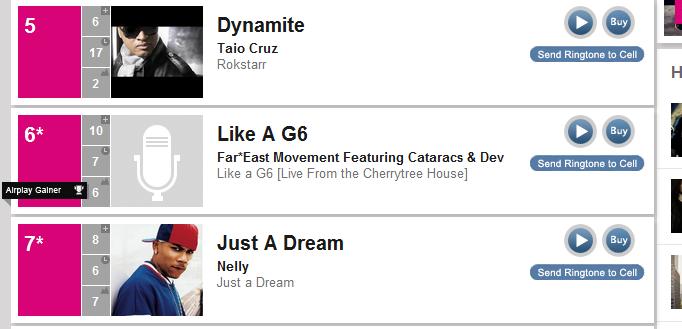
I…alright. I’ve never heard this song, nor anything about the artist. Gimmie a few, I’ll be back. Seriously, get some coffee or work on a sudoko or wonder why you don’t have more followers on Twitter, I’ll be back.

[time passes]

…there are literally no redeeming qualities to this song. None. I mean, I can’t even count the fact that it ends as a good thing because shit like this shouldn’t have even began. I’ve never heard of Far East Movement (a rap posse of Asian-Americans), and I wish I could un-hear of them and this song.

This has to be a fluke hit. There is no trace of professionalism or craft to this. There’s barely even a beat. It sounds like they opened a GarageBand file, blindly punched in a few notes and rhythms, and said, “Hey, no one’s going to listen to this, good enough”. Add in mechanical handclaps and the most generic tiss-kah-tiss effect so bland it’s probably “Default #1” on beats, and that’s the mainstay of the music. Hell, reading this review probably takes more time than they spent on the music/production.

And they probably didn’t spend much more time on the lyrics. I never thought I’d use Ke$ha as the higher artist, but freaking “Tik Tok” covered the “Tool at a party” field better than these dweebs did. Just read the hook if you doubt me: “Poppin’ bottles in the ice, like a blizzard/When we drink we do it right, gettin’ slizzard/Sippin’ sizzurp in my ride, like Three 6/Now I’m feelin so fly, like a G6/Like a G6, Like a G6/Now I’m feelin’ so fly like a G6”.

Run through the checklist of terrible choices with me. Empty boasting? Check! Making words up? Check! Stupid to the point of offensive? Check! And last but not least, being so damn lazy you rhymed six with six? Check!

Here’s a fun fact, there’s no model “G6” plane. Wikipedia has a list of what it means here. So if you want to feel so fly like Far East Movement, that means you feel as fly as:
-The 6 most powerful European Union members (Pretty fly).
-Group 6 of the periodic table, which includes chromium, molybdenum,  tungsten, and seaborgium (fairly fly).
-Spot G6 on a chess board, which is 1 square up from where a black pawn starts (not fly at all).

The rest of the lyrics are just as terrible. There’s lines revealing (shocker) a penchant for expensive alcohol, how gangsta it is to be sippin’ at the club, something about putting hands up, and this repeated gem, “When sober girls around me actin-actin like they drunk”, a line so terrible that its very existence makes me feel bad for the English language.

There’s bad songs out there, and then there’s “Like a G6”. It’s as if someone found Ke$ha’s Asian-American extended family, got them trashed on absinthe laced with meth, guided them to a MacBook with GarageBand, told them to write a song that sounds dated already, and put the results on the radio. I haven’t been able to find anything about it being ironic or a parody, but even if it was, it doesn’t matter because of how bad it truly is. This might legitimately be the worst song I’ve heard on the radio all year.

Posted in Radio Rants | Tagged , , , , , , | 7 Comments

What the Hell Is “Indie”?

Let’s talk about “indie”.

The term originated as a shorter way to say “Independent music”, that is, artists who weren’t signed to a major label. And, in the minds of some purists, that’s what it means today. But then “indie rock” started being used in the 80s to describe the jangly, effects driven branch of alternative rock (ex: R.E.M., The Stone Roses, The Smiths). Indie pop was born out of a similar style, and was really indie rock’s calmer, shy little sister.

Looking at the late 80s, it becomes damn hard to tell what was the difference between “indie” and “alternative”. As far as I can tell (because I wasn’t around at the time), the two of them essentially meant the same thing depending on who you were talking to. Independent labels started creeping up around this point, such as Sarah Records (indie pop HQ), SST (who quickly became the default “you’ve made it” indie label, like Matador today), and Sub Pop (first to sign Nirvana and Soundgarden, and still active today).

But looking back at the early 90s, it’s clear to see that a line was drawn somewhere. The artists that blitzed the mainstream between 1990 and 1994 (Nirvana, Smashing Pumpkins, Weezer, Pearl Jam, Green Day, Jane’s Addicti–fuck it, anyone played Lollapalooza between those years) were quickly and decisively labeled as “alternative”, and the term took on a new meaning. It still sounded counter-cultural, but as the 90s went on and major labels signed any band with odd dressed members and a fuzzed out sound, well, it became pretty played out. Alternative rock became more about a certain sound and less about an attitude and approach. It became marketable. And around 1998, “alternative rock” entered a dark age.

Meanwhile, “indie” stayed relatively underground as a music and cultural movement. Pavement, Neutral Milk Hotel, Beck, and Modest Mouse (to name a few) were busy pumping out high quality records that never enjoyed mainstream appeal, but have gone down as genre-defining records in the past decade.

But then indie got its turn. It’s a little harder to pin down when indie broke, but 2004 sounds pretty good. The Yeah Yeah Yeahs had put out “Fever to Tell” the year before, Franz Ferdinand dropped their self-titled that year, and Modest Mouse got huge with “Good News For People Who Love Bad News” and that album’s big single, “Float On”. And “indie” has been in mainstream vocabulary ever since.

And the biggest question about indie since then has been “is it a genre?”

This is where that whole “genres” thing gets dicey again because everyone’s a little different. According to some people, genre extends purely as far as the musical notes and the way they sound. And then according to others, genre is your sound, your look, your attitude, and your location. The trouble with genres (as I wrote about previously) is that there’s little universality to some of them, like indie, or punk (which is a whole other issue I want to cover). But without at least a decent shot at defining a genre, we’re not able to move forward as to what indie is. So I’m going to define a music genre as being a shorthand term to describe the general sound, principles, and look of an artist. Probably not a perfect definition, but it works.

That said, I would consider “indie” to be a music genre. From Iron & Wine to Modest Mouse to Yeah Yeah Yeahs to your older brother’s basement band, just saying “indie” gives you a rough idea of the music, look, and principles of the artist. Nowadays, I doubt that “indie” could really apply to a scene since there are so many subgenres under the indie tent, but as a genre, it certainly works.

So then looking to the future, the question becomes “What will become of indie?” And that might not be a happy answer for some people. “Indie” is quickly going the route of “alternative” in the 90s. In layman’s terms at least. It started with “Juno”, which had a hilariously high amount of indie music, but was more of a crossover fluke than anything. My “favorite” example would be the soundtracks for the Twilight movies. The most shamelessly cash-grabbing, tabloid featured, mainstream movie series in memory has the most ostensibly “indie” soundtrack. And with the advent of the internet, more people are able to discover indie music faster and easier.

What I think is going to happen is an eventual breaking point and redefinition of terms. “Indie” will become the new alternative (at least in the mainstream), some new labels will be drawn up, some old ones perhaps reassigned, and we’ll keep on listening.

But you’ve probably never heard of it, anyway.

Posted in "Thoughts" | Tagged , , , , | Leave a comment

Mini Mixtape #3

Mini Mixtapes, it’s like 4 songs for the price of nothing! Because it is! Ok, the theme this week is fall, because the weather kicked over straight into fall territory this week. So here’s 4 songs great for bonfire going, leaf stomping, or star gazing.

Karen O & the Kids – All Is Love (2009)
This is from the “Where The Wild Things Are” soundtrack, which in itself could have been today’s Mini Mixtape. But “All Is Love” is the most accessible of the bunch, and was actually a single. Just takes you back to childhood, don’t it?

Led Zeppelin – Tangerine (1970)
One of the many shocking chill cuts from Led Zeppelins’s third album, “Tangerine” stands out as being an innocent love song. Definitely a great song to just relax to, or play on a porch. Also featured in the movie “Almost Famous”.

Foo Fighters – Summer’s End (2007)
A bonfire tune if I ever heard one. All the elements of later-day Foos are present here; great guitar work, a jam vibe, and a chorus you can sing with. A little long, but hey, it’s good background music. Great as a goodbye to summer song that doubles as class rock send-up.

Green Day – Wake Me Up When September Ends (2004)
HAHA IT’S FUNNY BECAUSE SEPTEMBER ENDED YESTERDAY. Following that logic, click here.  Anyway, this “couldn’t escape it” hit off American Idiot used to be the bane of my existence, but it’s just a fitting song, you know?

Have a great Friday/Saturday!

Posted in Mini Mixtapes | Tagged , , , , , , | Leave a comment

Album Review: Karen Elson – The Ghost Who Walks

Karen Elson’s made a career for herself as a model. That fact, combined with the fact that it’s her name in the title, probably triggered a knee jerk reaction somewhere. However, she was also a member of the political cabaret group the Citizens Band, as well as a few other projects here and there. But most people are still wary of this release. Ok, does the fact that Jack White is her husband help any?

Alright, might as well get the quick and dirty parts out of the way. Without Jack, this album wouldn’t have happened, not at least on a scale where people would hear about it. The story is he heard her singing a song or two, got enthused, headed off to Third Man studio with a back band for his lady, and here we are. White himself plays drums and produces, and it’s hard to ignore his presence here; The Ghost Who Walks has that old-fashioned, rustic mix that was on The Dead Weather’s last album as well. Speaking of TDW, Dead Weathermen Jack Lawrence (who might as well be the only bassist White trusts) and Dean Fertita appear here, as do other members of Third Man’s revolving door lineup.

While there’s the implied Third Man “brand” here, The Ghost Who Walks is very much Elson’s record. Of 12 songs, she wrote 8 on her own, and three more were co-writes with Citizen Band members Rachelle Garniez (the sole writer of “Lunasa”) and Duke Bojadziev. Only once does White’s influence become too apparent; second song “The Truth Is in the Dirt” with it’s psychedelic keyboards and drum and bass groove sounds like a calmer Dead Weather cut.

Elson’s forte is an oddly gothic folk and  vintage country sound. Normally I’d use a song or two as an example, but it’s so pervasive here that picking any song would give you an idea of what I mean. Aside from the usual band set up, slide guitars, fiddles, and an accordion adorn songs like “The Last Laugh” and “Stolen Roses”. Elson picks up the persona of the singer-songwriter with stories to tell, and boy are they a dark sort. There’s a preoccupation with sadness, nature, and the darker sides of man, and Elson’s morose delivery is the real seller here.

The better songs on The Ghost Who Walks are the ones where Elson isn’t afraid to make a scene. Such is the case with “100 Years From Now”, a cabaret throwback to Karen’s days in the Citizens Band, and has such a spooky romanticism to it I’m surprised Tim Burton hasn’t tried to get licensing for it in a movie. “Garden”, which might be the best song here, benefits greatly from Elson’s dramatic vocal and urgent music. The same goes for closer “Mouths to Feed”. Meanwhile, Garniez-written “Lunasa” is a particularly pretty Nashville ballroom piece, and the murder ballad title track is the perfect choice for an opener.

The times that The Ghost Who Walks misses, it’s in a very Jack White sort of way, particularly the issue that’s dogged The Dead Weather’s (few) lesser songs. The misses here aren’t misses because they’re bad or messy, but because they lack that special something that holds your attention. And despite a few stylistic flourishes, some of these songs can bleed together a bit too well sometimes. While the dramatic moments are great, they are also too few; a shock of life here and there would go a long way.

Is this a bad album? Not at all. Karen Elson is definitely talented, as is the band behind her. With a little work and some editing (I can’t imagine Jack giving his wife that much criticism), Elson could establish herself as one of the better singer-songwriters of the modern alternative scene. As it is, she’s already more than halfway there. Three out of five.

tl;dr: Karen Elson’s dark country debut shows that this model is more than a pretty face. Three out of five.

Posted in Album Reviews | Tagged , , , , , | Leave a comment