Radio Rant: Selena Gomez – Same Old Love

Hello, and welcome to Radio Rants.

We’ve got kind of an issue here today. One part due to Listmas, one part due to other reviews, and one part due to the charts holding onto the same handful songs for last three months, I’ve recently written about everyone in this week’s top ten already. “Hello”, “Stressed Out”, “Stitches”, and “Here” have all gotten individual treatment, and I just don’t have it in me to write about Meghan Trainor’s latest throwback track, or the shell game Bieber’s playing with “Where Are U Now?” again. So, even though she’s gotten recent coverage, bring on Selena.

Selena Gomez has carved out a lane for herself one of our purest B-level pop artists. That’s not to say that she’s B-listed as a celebrity, but that her career highlights the difference between a pop artist and a pop star. This isn’t a bad thing. While she’s not doing Swiftian numbers, Gomez leveraged her Disney fame to start an adult pop career with five top ten hits over not quite three years. She’s done this without needing a career reset already like Bieber or (probably) Ariana Grande, and has a consistency that Demi Lovato and Nick Jonas haven’t been able to match. And this consistency is reflected in her singles: sometimes she soars, sometimes she whiffs, but it averages out to a potentially resilient career.

All of this makes her easy to appreciate, but means it can be hard to plumb her material for anything beyond “it’s fine.” We’re gonna try anyway. “Same Old Love” is Revival‘s second single following “Good For You”, and while it shares that song’s aspirations of doing you, that’s about all they have in common. “Good For You” was all hazy atmospherics, drum pads, and breathy vocals while “Same Old Love” is pared down to stabbing piano chords and programmed snaps for its foundation with Gomez singing with her chest all the way out. It manages to sound like it belongs on contemporary radio stations, but could have credibly gotten air play at any point in the last few years.

That’s likely due to veterans Stargate and Benny Blanco producing the track. “Same Old Love”‘s verses are made of the aforementioned piano chords and snaps, but the chorus tosses in some flourishes like upstroked guitar to match the piano parts, deep bass, and a synth line that I swear reminds me of an old N64 video game. Even with those extra touches, “Same Old Love” is scaled back from Stargate or Blanco’s usual efforts (Iggy Azalea’s “Black Widow” was another joint project), and the song stands out a bit on the radio as a result. Gomez isn’t trying to rule the charts so much as keep her place in them. The beat doesn’t get in the way, and that might be a problem; it’s fine as a composition, but feels like an outtake or a demo, like a grounding element’s missing.

Gomez’s performance only throws the sparse track in relief. Like I said, she’s singing here with more assurance and force than usual, throwing voice breaks and the slightest hint of a  bratty snarl into her delivery. She throws a little more into the chorus, and while it could be a little grating, a hint of attitude fits her well. The effect does her favors, but hurts the beat by pointing out how little there is to it. Actually, between the upstroke guitars, baby brat vocals, and overall off-kilter vibe, Gomez is doing a good to great Gwen Stefani impression.

She also gets an assist with an uncredited backing vocal from Charli “Huh, this crossover thing’s harder than it looks” XCX, who is also a credited writer. Charli contributes those “Ooh oh whoa oh whoa”s you hear on the chorus, and while it’s cool to hear her on a hit, it’s also really hard to differentiate her and Gomez if you’re not trying. A lot of that comes down to just how in Charli’s wheelhouse “Same Old Love” sounds; with a little extra dressing, it could have fit in on her album Sucker. As is, the song’s too slight to plausibly fit on that record, but considering that Sucker stiffed the charts, I’m not sure that’s necessarily a knock as far as Gomez is concerned. Let’s see some lyrics.

“Take away your things and go/You can’t take back what you said, I know/I’ve heard it all before, at least a million times/I’m not one to forget, you know” The argument’s floating around out there that “Same Old Love” is about Gomez’s famous former beau Justin Bieber, whose tried to rekindle what they had for a while–likewise, people think his “Sorry” and “Love Yourself” are about her. The official party line is that “Same Old Love”‘s about “negative love” and “not necessarily romantic”, so believe what you want.

“You left me in peace/You left me in pieces” This lyric’s great at riding the line between good-clever and ugh-clever.

“I’m so sick of that same old love/That shit, it tears me up” I get the impact that throwing “shit” in there has, especially for Gomez who still seems kinda like a kid, but I’m always confused when designer radio singles throw swear words in the chorus (aside from “Fuck You”. “Fuck You” is transcendent.)

“I’m so sick of that same old love/My body’s had enough” Taking “Your Love Is My Drug” to the logical limit, huh?

“I’m so sick of that same old love/feels like I’ve blown up boy” File this one under “lyrics that aren’t helping the Bieber conspiracy theorists”.

If you want to look at “Same Old Love” as a step forward, you can, but mostly it’s regulated to “it’s fine” status. It showcases Gomez being a little cocky, and more or less works due to the strength of the hook. It’s pop music at its most functional: “Same Old Love” is exactly as good and memorable as it needs to be for Gomez to huff it to her next single without leaving much in its wake. Bring on “Hands To Myself”.

Posted in Uncategorized | Tagged , , , , , , | Leave a comment

Fall Out Boy’s Albums From Worst to Best, Ranked

A few years back, music writer Steven Hyden ran a feature for the now defunct Grantland called “The Winner’s History of Rock & Roll”, where he profiled bands from Led Zeppelin onward who, well, “won” rock in the mainstream culture. The piece aimed to seek out who defined what a mainstream rock band looked like, sounded like, acted like, how their videos looked, who they worked with, and what they did for a given era. And these were winners in the biggest sense possible; the winners list wasn’t one of Talking Heads, Nirvana, and The Strokes, but of Bon Jovi, 90’s Metallica, and Linkin Park. While Hyden’s Winner’s History ends in 2013 with The Black Keys, I’d wager that a new winner was about to announce their comeback later that year: pop-punkers turned emo arena rockers Fall Out Boy, 2015’s winning rock band.

The year-end Billboard charts always feature a handful of token rock singles. Last year, Fall Out Boy took two of those spots with “Centuries” and “Uma Thurman” from their sixth studio album American Beauty/American Psycho which sold half a million copies. Doing those kinds of album numbers, plus notching hit singles as a rock band on back to back albums when you’re neither a young group coming up with a rabid fanbase or a warmed over corporate act who can’t keep at for more than an album cycle is practically unheard of in the 2010s (Coldplay, Imagine Dragons, and Mumford & Sons all stiffed the charts in one regard or another, although Coldplay is still early in their album cycle).

And so, to celebrate, I thought I’d rank Fall Out Boy’s discography. This band of misfit Chicagoans went from scene pariahs to world conquerors; there has to be something in their albums that explains it. This ranking’s also going to be interesting for me because, despite this band being arguably the defining group for my teenage years and onward, I’ve gone on record here as not a fan. Let’s call it a growing opportunity. Anyway, as FOB’s lead singer Patrick Stump once said (ish), this ain’t a scene, it’s a GOD. DAMN. RANK. ING. Ahem, sorry.

6. Save Rock & Roll (2013)
Fall Out Boy took a hiatus in late 2009, and announced their return with Save Rock & Roll in 2013. I didn’t like the album when it came out, and it hasn’t gotten any better with time. Fall Out Boy were always a vain and kind of callous band, but they never felt as shallow as they do on SR&R, where the songs lack adventure, and the garish production reduces everything to a bland gruel. To this day, the album remains one great song (the comeback heralding “The Phoenix”), one near great one with hit single “My Songs Know What You Did in the Dark”, and nine songs that are more loud than they are spirited.

I’ll say this in my bottom pick’s defense: rather than retread the band’s past, it kept them on the charts by keeping them current like true rock and roll winners. To that end, it almost doesn’t matter that the Big Sean featuring “The Mighty Fall” is terrible, at least it sounds like something made in 2013 that would feature Big Sean. Still, though, if there was one FOB album I’d watch 2 Chainz toss in a fire, this is it.
5. American Beauty/American Psycho (2015)
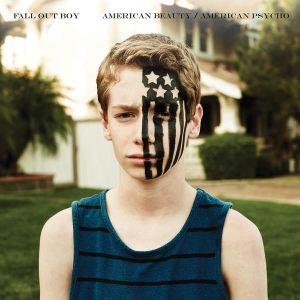
To prove the reunion wasn’t a cash-in, FOB recorded the follow-up to Save Rock & Roll less than two years later (aside: so long as they’re active, Fall Out Boy have never gone over two years without putting out an album. No matter what you or I think of them, you gotta respect the hustle). AB/AP is just as big, rushed, shrill as its predecessor, but feels more comfortable with itself and a lot zanier. The hip-hop stomp of “Irresistible”, zippy energy of the title track, or that Munsters sample on “Uma Thurman” are AB/AP‘s all on its own, and stay truer to FOB’s roots as a band who’ll try anything it see what works. In concept, I can appreciate an album like this that wants to run away with every idea and be as big as possible. In actuality, too many of the songs seem listless, and the brittle production makes even good tunes like “The Kids Aren’t Alright” a bit of a headache. There’s nothing that would imply FOB would scale back from here, but AB/AP is a competent album, if nothing else.

4. Take This To Your Grave (2003)
Here’s one for you: at their inception, Fall Out Boy was a band made two Chicago hardcore castoffs who switched between guitar and bass, a straight-edge vegan drummer who was originally filling in as a favor, and a shy dude who joined as a drummer and had to be press-ganged into singing instead.

I say all this because it helps contextualize their debut album Take This To Your Grave as more a proof-of-concept than anything else. Fall Out Boy’s first album is tight and likeable, but weakest in their pre-hiatus discography for a few reasons. While it’s energetic, the hooks aren’t as sharp as they are later; it’s hard to differentiate even decent songs like “Sending Postcards From A Plane Crash (Wish You Were Here)” and “The Pros and Cons of Breathing” once they end. Stump’s pretty green as a singer here, too, not doing much to separate himself from the glut of early 00s pop-punk dudes singing about girls. The album’s full-throttle tempo’s good for jamming along, but it’s missing that Fall Out Boy bounce.

Take This To Your Grave is the only FOB album I didn’t experience contemporarily. I don’t know how much that’s colored my view of it, but looking at the album compared to what comes next, it feels slight. Ultimately, TTTYG comes up short because FOB aren’t especially realized as “get in the van” types playing day slots at Warped Tour, and if you want to argue that they arethen this album’s nothing but a practice swing for From Under the Cork Tree.

3. Folie a Deux (2008)
Albums release right before a band goes on hiatus or split end up being interesting the same way those last few doomed dates are before a break-up: all of a sudden, you’re looking at details like a “date night” consisting Olive Garden and a Gerard Butler movie, or bringing labelmates and scene buddies in to sing your old hits on an outro like those details were warning signs all along.

Folie a Deux isn’t Fall Out Boy’s best album, but it’s handily their most fascinating. The band hadn’t taken an honest break in fours years that included extensive touring to a highly devoted fan base, prolonged media attention on Pete Wentz and Patrick Stump, and recording three increasingly large and involved albums, and you can hear the fatigue catching up to them all over Folie a Deux. It has that blown out, battered sound of an artist trying to grit their teeth, pull through their exhaustion, and just will an album into existence (see also: The Beatles’ Let It Be, Arctic Monkeys’ Humbug, Yeezus). FOB’s songs have always had a level of emotional detachment despite the “emo” tag, but Stump sings Wentz’s lyrics like “I must confess, I’m in love with my own sins”“I’ve got troubled thoughts, and the self-esteem to match/What a catch”, and album opener “I’m coming apart at the seams/Pitching myself for leads in other people’s dreams” with an earnestness previously missing. The music looks at pop, rock, soul, and tinges of punk and metal through a funhouse mirror, resulting in synth-tinged stompers like “I Don’t Care”, chamber poppy “What a Catch, Donnie”, hair metal-with-horns and piano rocker “Headfirst Slide Into Cooperstown On a Bad Bet”, and Pharrell produced “w.a.m.s.”

But Folie a Deux doesnt’ rank high just for being weird, but for having some of the band’s best songs. Fans didn’t know what to make of “I Don’t Care” in 2008, but years later, it’s a killer diva cut for Stump. “She’s My Winona” is near melodically unmatched in FOB’s discography, and downright joyous, too–try not to singalong to the chorus or that “Whoa-oh-oh-oh whoooaa” hook. And “America’s Suitehearts” and “What a Catch, Donnie” are both top 5 contenders, period. With a few stronger songs (there’s a bit of a mid-album stumble) and better production, it’d be Fall Out Boy’s best album. As such, it doesn’t quite pass muster, but it’s probably my favorite of theirs, nonetheless.

2. From Under the Cork Tree (2005)
Yes, Fall Out Boy, you were more than we bargained for.

But, they proved they were here to win. Second record From Under the Cork Tree takes everything that worked on Take This To Your Grave and jumps over it. The ridiculously tight rhythms do more than standard pop-punk beats, the overcaffienated riffs develop into actual, lethal hooks, Patrick Stump discovers his range, and the band’s identity snaps into focus. Like, you’re not gonna hear “Dance, Dance” and think of someone other than Fall Out Boy, and the record’s first half is the band’s best run of unleaded pop-punk. It’s also their bitchiest album by a country mile; not until you hear “Why don’t you show me a little bit of spine you’ve been saving for his mattress”, “I’m just a notch in your bedpost, you’re just a line in a song”, and the entirety of “I Slept With Someone In Fall Out Boy And All I Got Was This Stupid Song Written About Me” all within the same hour that you realize just how big the chip was on Pete Wentz’s shoulder.

Of all Fall Out Boys albums, this was the one where nostalgia hit. In retrospect it’s basically an accomplished pop-punk album, but between Cork Tree and My Chemical Romance’s Three Cheers For Sweet Revenge picking up steam with the “Helena” video, you could watch the emo pop phenomenon take on in real time. Tons of kids bought this record, and “Sugar, We’re Going Down” is a legitimate rock radio staple people still know (a few of) the words to–it kills at college bars around 1:30 AM, if you ever have the chance/right jukebox. Without Cork Tree doing so well, it’s hard to say that people would have given The Academy Is…, Say Anything, Paramore, Gym Class Heroes, and especially Panic! at the Disco (*please click here for Ranting About Music’s in-depth look at PatD’s albums) the time of day. And while it’s good, it’s still not Fall Out Boy’s best album.

1. Infinity On High (2007)
The longest standing criticism of Fall Out Boy that’s gone from (depending on who you talk to) 2005 or 2007 to now is that they sold out or they’re no longer a “true” pop-punk band. Setting aside that the “not a real band/sell out” argument is one the least productive things you can say about an artist, it also misses the point to Fall Out Boy. Don’t let Take This To Your Grave fool you: playing fast and loose with form and genre while keeping big riffs, clever (slash “clever”) lyrics, and pop choruses is wired into this band’s DNA far more than Vans slip ons and long sideburns ever were.

Infinity On High is the album that proves it. The material was written while touring, and as a result, the guitars, bass, and drums have a loose, natural chemistry that makes for standout rockers like “Hum Hallelujah”, “Fame < Infamy”, or “You’re Crashing, But You’re No Wave”, and that confidence helps the band ease into new elements like strings, bouncing soul (“This Ain’t a Scene…”), dalliances in Weezery power-pop (“I’m Like a Lawyer…”) and even a piano ballad with “Golden”. Wentz drops some of the lyrical pettiness, but it’s Stump who steals the show on this one. If Cork Tree was about him developing confidence and presence, Infinity On High is where he truly lets loose, pulling off shit like this and layering tracks with his own harmonies. He sounds fully realized here, and so does the band behind him; “The Carpal Tunnel of Love” is a heavyweight emo jam on its own, but it’s arguably the band’s best song all because Stump sings the fuck out of it.

And Infinity On High doesn’t lack for strong material elsewhere. “Thnks Fr Th Mmrs” is the band’s most enduring non-Cork Tree single, and the mid-album run from “I’m Like a Lawyer…” to “Don’t You Know Who I Think I Am?” is solidly bulletproof with a few great songs littering the back half. FOB cranked out Infinity less than two years after its predecessor; partially because they wanted to keep their profile and momentum going forward, but they were also on a creative hot streak. Even now, this album is the one they’re chasing: Folie is the comedown from the High, and post-reunion records Save Rock and Roll and American Beauty/American Psycho are lobotomized and lobotomized-but-somehow-zanier takes on Infinity respectively.

Maybe if they were never destined to save it, this album is the one that proves Fall Out Boy was meant to win rock and roll. They were able to harness their sound and tweak it to trends, while still keeping a lead in their own scene and up-size without difficulty. I still wouldn’t call myself a fan of theirs, per se, but they’re better than I gave them credit for. Thanks for the memories, dudes. And some of the songs, I guess.

Ranting Research Notes
1. I always thought that the bassline to “Dance, Dance” was Pete Wentz’s lone quality bass riff, and it turns out Patrick Stump wrote it. Go figure.
2. The Alluded to Fall Out Boy Top Five Songs List (in loose order): “The Carpal Tunnel of Love”, “Dance, Dance”, “She’s My Winona”, “Thnks Fr Th Mmrs”, “Saturday”.
3. Fall Out Boy dress like fairly normal dudes in the “Sugar, We’re Goin Down” video, only to go for the slack formal wear and eyeliner with “Dance, Dance”. “Helena” was released between the two.
4. Speaking of video, Fall Out Boy exist in that fun span from 2006-2008 where even TV performances and music videos uploaded to YouTube look like they were shot with a Razr.
5. The band’s 2002 demo Fall Out Boy’s Evening Out With Your Girlfriend wasn’t counted because they’ve essentially disowned it, and a label only did a reissue without their consent. 2013’s hardcore EP Pax AM Days and last year’s Make America Psycho Again remix project were similarly nixed, although here’s how I’d rank the three: I’d rather take my chances with Panic! at the Disco’s new album.

Posted in "Thoughts", Lists | Tagged , , , , , , , , , , , , , , , , , | 1 Comment

The Enduring Identity of David Bowie

David Bowie died yesterday.

This is a factual statement, but somehow feels implausible and a little unfair. He had just turned 69 on Friday! He emerged from semi-retirement just two years ago with a pretty good album, and followed it up last week with an insane record that feels vital while his contemporaries are making inessential solo records and cover projects. Sure, interviews and tours were still off the table like they’d been since 2006, but the man’s recent work radiated life. It felt like throwing something off-balance; the cosmos just came for an old school rock icon two weeks ago. If most of us were asked “who do you think would live forever?” I’d wager “David fucking Bowie” would be a common answer.

If you’re here, I imagine you know the beats of Bowie’s story from “Space Oddity” to Ziggy Stardust to the Thin White Duke to bleached pophead to 90s goatee to the Blackstar. At the very least, you’re probably aware Bowie was “that redhead with the lightning bolt”. Honestly, I’m not a Bowie expert–you’d have to dedicate a solid few months to this archive panic of a discography for that–but I know and love a lot of the man’s work, and his passing’s made me realize just how much he resonated with me.

And, based on the massive outpouring of shared grief and Bowie stories, I’m not alone in that. Seeing Lemmy and Bowie go back to back confronts a sad truth: as more rock icons reach a certain age, rock icons succumbing to said certain age is going to be a more frequent phenomenon going forward. And while they’ll hurt, I can’t see many of them tripping people up as hard as David Bowie has.

Let’s talk about David Bowie and identity.

If most people get into older rock (let’s say anything before 1980), it’s going to be when they’re a teenager, and still tacking down their identity. In that time, you’re looking at guys like Mick and Keef, Bob Dylan, Robert Plant, Lou Reed, Iggy Pop, and–sure, let’s add him–Lemmy. They’re gods of cool, but it’s this very masculine white dude kind of cool that seems innate, and something your dorky ass isn’t going to imitate no matter how much swagger you affect or how detached you try to look while wearing sunglasses inside. It’s that jockish cool that, let’s face it, if you’re looking for an identity through music, you already know isn’t for you. And then, you look at Bowie during the Ziggy Stardust/Aladdin Sane years: this campy, androgynous, bisexual alien as played by a man with dyed hair, makeup, and a killer wardrobe.

Ziggy Stardust caught on, yes because David Bowie was charisma incarnate, but also because he used life as an alien was a way to show the fluidity of identity in real-time. For kids who turned to rock because they felt like losers, freaks, or weirdos (“a little queer”, if you will), Bowie and Ziggy represented endless and exciting possibilities about self-expression. He showed that there was more to rock’s cool than macho posturing, that the genre could have a theatrical side, and how its sexual expression could be exciting and liberating (non-musical sidenote: I’ve never actually seen Labyrinth, but I’ve enough first person accounts about Bowie and his codpiece causing kids’ first “Why, hello there” moments to know it’s a Thing. Also, tell me you’ve never wanted someone to look at you the way Bowie does in this last gif). And, as he went through the years, Bowie demonstrated that said identity could take on whatever form you felt comfortable with, so long as it was what you wanted to do. Coming out of a year that Wesley Morris at New York Times called “The Year We Obsessed Over Identity”, Bowie and his many forms have a new resonance in popular culture.

That resonance also comes from the fact that, even when he was out of the spotlight, Bowie felt culturally present in a way that Dylan or the Stones haven’t for years, if not decades. Part of that was his work ethic; even as late as the early 00s, he was still releasing albums that–if they weren’t always good–at least sounded contemporary, and his 2010’s work was still fully engaged (The Next Day is Bowie’s own career retrospective, while the just released Blackstar is a scorched Earth jazz rock affair whose solemnity came into hard focus today). But the other part is how visible his legacy was even when he was still alive: he was still a known force in rock, and one of our defining pop stars underlined his influence in her first music video.

Thinking about Bowie and identity, it feels worth noting that Ziggy Stardust came to Earth to save it and spread a message of peace. That Bowie died peacefully while with his family, and not by rock and roll suicide, feels like a fitting end to that transmission. David Bowie showed us, showed me at least, that the world could be a weirder, more exciting place if you embraced your own fluidity. You might blow your own mind.

Posted in "Thoughts" | Tagged , , , , | Leave a comment

What If Kanye West Just Doesn’t Release SWISH?

As much as 2015 was defined by a glut of stupid great albums, it was also defined by three big name no-shows that seemed like sure things: Frank Ocean, Rihanna, and Kanye West. Of the three, Frank Ocean is the most open and shut situation with an announcement last year slating the album for July, and then, save one cancelled appearance at FYF, nothing since. Rihanna’s ANTI seems to both exist and not exist simultaneously: one week, her camp says it’s coming any second, the next, there’s buzz about her still looking for songs. Things get weirder with Kanye and  SWISH: we got three singles for a presumed promo cycle early last year, an album name change, a few songs chiefly used to soundtrack Kanye’s fashion line, and whatever you want to call “FACTS”. The blustery “it’s totally finished” hype statements from the last year clash with this “time to buckle down and work” tweet last month from Kanye, and lately I’ve been wondering:

What if Kanye just doesn’t release another album?

Okay, deep breath, because there are a few qualifiers: I’m not ruling out production jobs, guest verse features or collaborations (I wouldn’t want to live in a world without the possibility of Watch the Throne 2), or the idea that Kanye would return to albums eventually, I’m just saying what if he’s done with the “record–>single–>album–>videos–>tour–>record–>repeat” cycle? We could be waiting for a Yeezus follow up for years.

Of course, this is speculation bordering on conspiracy theory, but there’s enough evidence to make the case. You listen to 2015’s main Kanye tracks: the parental lullaby “Only One”, Rihanna featuring acoustic jam “FourFiveSeconds”, and grimy, mean-mugging “All Day”, and while they’re all great, they sound like an artist tinkering in private. Ditto for his “Say You Will” remix with Caroline Shaw, and reworked 808s shows last year; the material’s compelling, but more focused on proof-of-concept than world (or radio) domination. The three singles come and go of their own accord without a unifying energy or sound. Most of this could be applied to Rihanna’s 2015 songs, but Riri seems committed to ANTI enough that she’s going on a tour for it a tour for it at the end of next month, and an app. Kanye’s most recent SoundCloud loosie was a What a Time to Be Alive aping track with Metro Boomin, which is the very definition of fucking around.

And then, you look at Kanye’s non-musical life, and SWISH slides even further down the priority list. Most of his 2015 was spent focused on his fashion line (potential name: Dystopia By Yeezy), and, I’d presume, raising his child and preparing for his second one. He’s got a full family with obligations now, and that has to make it harder to do shit like spend a year exploring sounds with Jon Brionworkshop around the clock in Honolulu, labor away in hotel rooms across the world, or Rick Rubin guided eleventh hour sessions. For Kanye (and a lot of artists), recording an album is a life consuming experience, and when life gets in the way, well, you end up being Tyga’s executive producer while you’re waiting to hear back from the fashion team.

So, getting back to that “What if”, I think we’ll still see plenty of Kanye both as a public figure and as a featured artist, but I feel like projects where he’s leading the charge will be harder to come by. And, let’s step back for a second and appreciate the man’s 2010’s hot streak: you didn’t have to love everything on My Beautiful Dark Twisted FantasyWatch the ThroneCruel Summer, or Yeezus, but the fact that those projects were all in a little under four years is damn impressive. Add on the relentless work ethic before that (four albums in five years), and the man’s earned the right to take the time off, if nothing else.

But the other part of the “What If”, the argument that makes it interesting and separates Kanye from Rihanna is that his discography as it stands makes a near perfect arc. Going from the rising action of the College trilogy to crippled loss of 808s & Heartbreak to MBDTF‘s maximalist appeal to the abrasive deconstruction of Yeezus is an incredible There and Back Again, right down to closing Yeezus with the corroded take on vintage Kanye that is “Bound 2”. As he once said, the man is so self-conscious, so this arc probably hasn’t escaped him. What’s more, Kanye is pushing 40 in a scene where north of 35 qualifies you as an elder; it’s entirely possible that he doesn’t feel the need to put out another album right now. Drake, Kanye’s most direct successor, proclaimed last year if he died he’d be a legend. Ye already is.

Now, watch him drop SWISH next week.

Ed: Two days later…


Posted in "Thoughts" | Tagged , , , | Leave a comment